Customer operations is the function that builds and runs the machinery behind customer support: processes, tools, staffing, quality assurance and reporting. Frontline agents answer customers, while customer operations makes sure they can do it well at scale.
In short
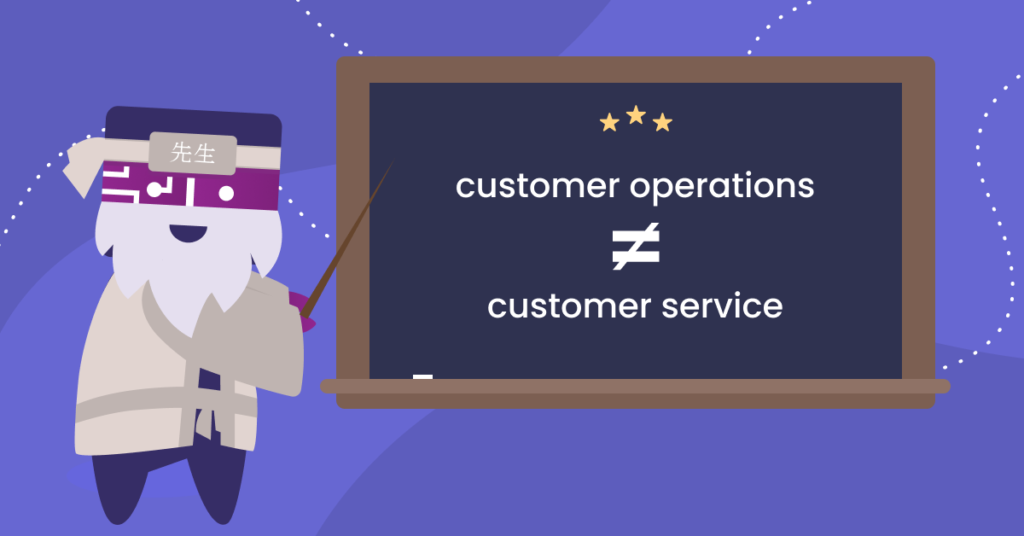
- Customer service handles each request. Customer operations designs the system around it.
- It owns processes, tooling, workforce planning, QA, coaching and reporting.
- Its job is fewer repeat contacts and agents who aren’t firefighting.
- You measure it with resolution, quality and satisfaction metrics, tracked over time.
What is customer operations?
Customer operations is an umbrella term for all the activities and processes a company uses to support its customers, from their first point of contact with the company, be it an advertisement, website visit or Google search, to their last.
Customer operations teams make sure the customer and prospect experience holds up across that whole journey. They work closely with marketing, analytics, sales and customer service to decide how customers get help, which tools agents use, and how the team learns from what customers say.
The main objective is simple: turn every interaction between a customer or prospect and the brand into a positive one. In practice that means removing the things that get in an agent’s way, such as spreadsheets, unclear policies and arguments about how to handle a specific case.
What does customer operations own?
The exact remit varies by company size. In most support organizations, it covers:
- Processes: how tickets are routed, escalated, tagged and closed, and what agents may decide on their own.
- Tooling: the help desk, knowledge base, chat and bots, integrations and automations.
- Workforce: forecasting, scheduling and staffing levels per channel.
- Quality: the scorecard, conversation reviews, calibration and coaching.
- Reporting: metrics, dashboards and the insights that go back to product and leadership.
Why is customer operations important?
Support is often the first place a company hears that something is broken. Customer operations decides whether that signal gets lost in a queue or reaches someone who can fix it. Done well, it is what keeps customers coming back.
Here are the main benefits of running customer operations well.
Customer satisfaction
Customers judge you on speed and accuracy. Zendesk’s 2026 CX Trends research found 86 percent of consumers say fast responses and accurate resolutions influence whether they buy. Good customer operations makes fast and accurate the default, whichever agent picks up.
Brand reputation
When customers have a good experience, they tell people. When they have a bad one, they tell more people, and often in public reviews. Consistent service across agents and channels protects your reputation better than the occasional heroic save does.
Customer retention
Better service reduces churn. Bain & Company research published in 2000 found that increasing customer retention rates by 5% can increase profits by 25% to 95%. The exact figure will differ for your business, but the direction has held up.
Competitive advantage
In many markets the products look alike. How quickly and competently you fix a problem is one of the few differences a customer feels directly, and it is hard for a competitor to copy.
What is the difference between customer service and customer operations?

In the early days of a business, the founder often handles every customer request personally. A few thousand customers later, the overflowing email inbox stops working.
At that point most companies move to a help desk such as Zendesk, Salesforce or Intercom, and build a dedicated customer service team trained to handle requests within specific business rules. This is what most people call customer support.
Customer service handles incoming requests. Customer operations develops the processes, tools and systems that make those requests easier to handle, for agents and for customers. Customer operations roles also tend to be more senior, with heavy analytical work and cross-functional collaboration with product, marketing and finance.
| Customer service | Customer operations | |
|---|---|---|
| Focus | The individual request | The system that handles all requests |
| Typical roles | Agents, team leads | Support ops, QA, workforce and tooling leads |
| Daily work | Answering tickets, calls and chats | Process design, tooling, staffing, QA, reporting |
| Success looks like | This customer’s issue is resolved | The same issue stops coming back |
| Key metrics | Response time, CSAT per ticket | First contact resolution, QA score, cost per contact, trends |
Support operations is usually the support-specific slice of customer operations. In smaller companies the two are the same team, and sometimes the same person.
How to improve customer operations management
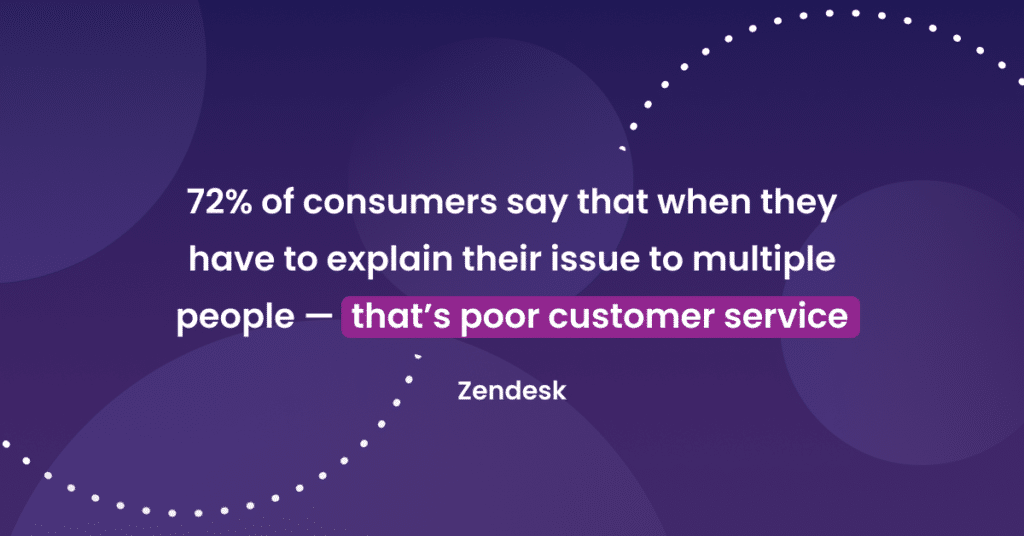
Empowering agents one by one matters, but the team also needs to work as a whole so nobody solves problems in their own bubble. Customers notice when they don’t. In a 2013 Dimensional Research survey for Zendesk, 72% of customers blamed a bad service experience on having to explain their problem to multiple people. Your team needs to handle a request on first contact instead of passing the customer around like a hot potato.
Without a clear process, it is easy to lose sight of your customer service goals. Here is where to start.
Improve your knowledge base
If your team answers the same questions over and over, there is an easy way to boost efficiency: build a knowledge base that customers and agents can both reach quickly. Agents should also see the customer’s contact details, product and history without asking for them again. A good knowledge base shortens response times and keeps answers consistent between agents.
Focus on customer success
Customer success is about helping customers reach their goals with your product. Focusing on it creates a better customer experience and stronger customer loyalty. Learn what customers are trying to achieve, then align your products, help content and service to that.
Find the right people
Hire people who care whether the customer succeeds. Consider hiring for empathy as well as skills. Product knowledge can be taught in weeks. A friendly, clear communicator is harder to train from scratch.
Have an effective process in place
Every team has a process, even if nobody wrote it down. Write it down. Agents should know how to handle inquiries and complaints, when to escalate and who owns what.
Customer operations usually means fine-tuning processes like quality assurance, performance management, coaching and reporting, so agents can focus on caring for customers. Establish clear customer service processes and give the team a toolbox they can rely on.
The right software tracks responses and escalates issues automatically. That frees people to resolve problems instead of updating spreadsheets about how many tickets closed last week.
Help customers help themselves
Nobody likes waiting. Self-service options like help center articles, FAQs and chatbots let customers fix simple issues in the quickest way possible, at any hour.
They also take repetitive work off your team, which leaves agents more time for the hard cases. Done well, self-service can improve customer satisfaction. Done badly, it becomes a maze customers escape by emailing you angrier, so check where customers drop out of self-service and fix those articles first.
Measure your success
Track response times, resolution rates, quality scores and customer satisfaction, and watch the trend rather than single weeks. Pair every number with a reason. A falling CSAT score tells you something is wrong. The conversations behind it tell you what.
Use automation

Use bots and automated replies for simple queries, routing and tagging, and keep people on the complex issues. Review what the automation does as carefully as you review agents. A bot that confidently gives a wrong answer creates the repeat contact you were trying to avoid.
Encourage feedback
Ask customers what they think of your service through surveys, feedback forms and social channels. Ask agents too. They know which policies, macros and tools slow them down, and they will tell you if they believe something will change.
How to structure customer operations as you grow
Most teams grow into customer operations in three steps.
- One person, part time. A senior agent or team lead owns the help desk setup, macros and the weekly report alongside their queue.
- A dedicated support ops role. Someone owns tooling, routing and metrics full time, and QA becomes a scheduled activity instead of a favour.
- A customer operations team. Separate owners for workforce planning, quality, tooling and insights, with one lead who reports on all of it.
Move to the next step when the current owner spends more time keeping things running than improving them. Waiting longer usually shows up as stale macros and reports nobody trusts.
Where quality assurance fits in customer operations
Quality assurance is where customer operations learns whether its processes work in real conversations. Most teams can only review a small sample by hand, which hides the patterns that matter: the macro that confuses customers, the policy that causes reopens, the handoff where context gets lost. Automated QA scores every conversation against your own scorecard, so trends show up within days. Those findings then feed coaching for agent issues and process fixes for everything else.
Frequently asked questions
What does a customer operations team do?
A customer operations team designs and runs the processes, tools and reporting behind customer support. That includes routing, help desk setup, staffing, quality assurance, coaching and metrics. Agents answer customers, and customer operations makes that work faster and more consistent.
Is customer operations the same as customer service?
No. Customer service handles individual requests from customers. Customer operations builds and improves the system those requests flow through. In small companies one team often does both.
What metrics does customer operations track?
Common ones are first contact resolution, average resolution time, CSAT, QA score, reopen rate, contact volume per customer and cost per contact. The useful habit is reading them together. Faster resolution with a falling QA score usually means agents are rushing.
What skills does a customer operations manager need?
Analytical skills come first, because the job is spotting patterns in tickets, metrics and schedules. They also need process design, tooling knowledge, and the ability to work with product, finance and frontline teams. Most have spent time on the frontline themselves.
See how Kaizo can help you on the journey!