Empathy in customer service is understanding what the customer feels and showing them you understand, before you fix anything. Below are 50 empathy statements organized by situation, plus how to use, train and measure them without sounding scripted.
In short
- Empathy means showing the customer you understand, then acting on it.
- Use statements as starting points and adapt them to each customer.
- Follow every empathy statement with a concrete next step.
- Score empathy on your QA scorecard so it stops being a poster word.
Every support team says it values empathy. Then a customer writes “I’ve explained this three times now” and gets back “Thank you for reaching out! We value your feedback.” This guide is about closing that gap.
What is empathy in customer service?
Empathy is accurately understanding the customer’s situation and emotion, and letting them see that you understand. It sits in the middle of a spectrum that support teams mix up constantly:
- Pity looks down: “that’s unfortunate.”
- Sympathy feels for someone: “I’m so sorry.”
- Empathy feels with someone: “you’ve lost two days to this, and it wasn’t your mistake.”
- Compassion adds action: understanding plus doing something about it.
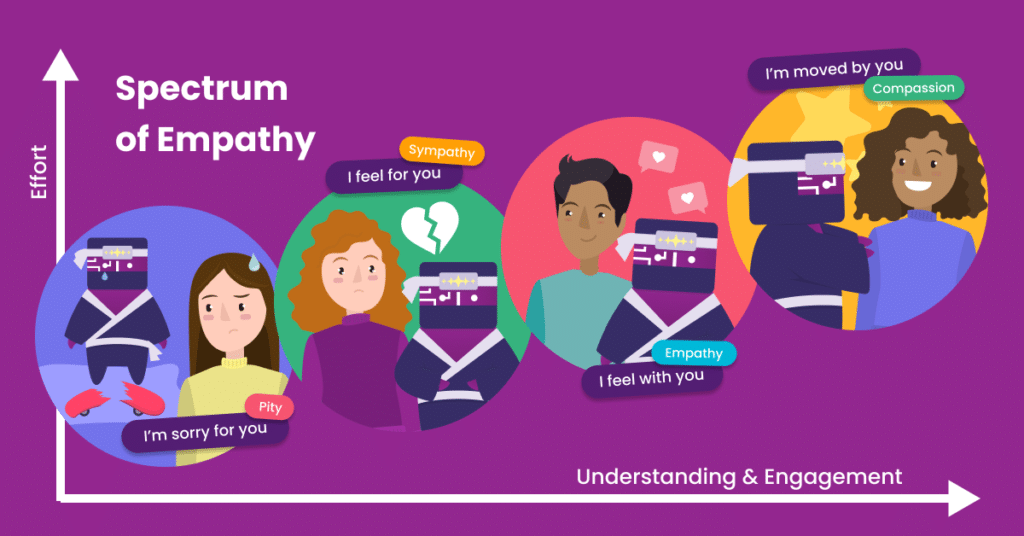
Customer service empathy is empathy plus compassion: understand, show it, then act. Which means an agent can be perfectly polite and completely non-empathetic, and a slightly blunt agent who nails the customer’s actual problem can score higher on empathy than a friendly one who doesn’t.
Why is empathy important in customer service?
Beyond decency, empathy does measurable work:
- It de-escalates. An accurately understood customer stops repeating and starts cooperating. Most escalations are volume increases in search of acknowledgment.
- It prevents silent churn. Customers who feel unheard rarely complain; they leave. Feeling heard is the cheapest retention lever you have, and its absence is a leading cause of customer dissatisfaction.
- It buys patience. A customer who trusts that you understand will wait for a real fix. One who doesn’t will demand escalation now.
- It protects your team. Agents trained to acknowledge emotion absorb less of it. Deflecting anger with templates is exhausting; meeting it with understanding is survivable. (That matters for burnout, too.)

50 empathy statements for customer service
One rule before the list: treat statements as starting points. Customers detect recited empathy instantly, and it reads worse than none. Adapt every line to the specific situation, use the customer’s own words, and never say anything you can’t back with action.
Which empathy statement to use when
| Situation | What the customer needs to hear | Go-to statement |
|---|---|---|
| Opening the conversation | You’ve understood, and they won’t have to repeat themselves | “I’ve read the first conversation, so you don’t need to repeat anything.” (#3) |
| Customer is frustrated or angry | Their reaction is fair, and someone now owns it | “I hear you. Let me take ownership of this from here.” (#15) |
| Solving the problem | What you’re doing and when they’ll hear back | “I don’t know the answer yet, but I know how to find it, and I’ll update you by [time].” (#22) |
| Waiting or delay | They haven’t been forgotten | “No progress yet, but I promised an update, so here it is.” (#32) |
| Saying no | A straight answer and the best alternative | “I can’t do that, and I’d rather be straight with you than string you along. Here’s what I can do.” (#36) |
| Closing | The issue is actually solved, and how to come back | “Before you go: did that actually solve it, or just part of it?” (#41) |
| Chat and email | Precision, because tone is invisible | “You asked two questions and I’m answering both, in order.” (#50) |
The full list, by situation:
Opening and acknowledgment (when the conversation starts)
- “Thanks for laying that out so clearly, let me make sure I’ve got it right.”
- “You’ve already tried the obvious fixes, so let’s skip those.”
- “I can see this is the second time you’ve contacted us about this. I’ve read the first conversation, so you don’t need to repeat anything.”
- “That would frustrate me too. Let’s get it sorted.”
- “You’ve come to the right place, and I’m going to stay with this until it’s fixed.”
- “I understand this is affecting your work right now, so I’ll be as quick as I can.”
- “Let me repeat that back to make sure I understand exactly what happened.”
- “That’s a completely reasonable thing to expect, and it didn’t happen. Let’s fix it.”
- “I appreciate your patience so far. You shouldn’t need much more of it.”
- “Before I dig in: is there anything else going on that I should know about?”
When the customer is frustrated or angry
- “You have every right to be frustrated. This should have worked.”
- “I’m not going to make excuses. Let me tell you what I can do.”
- “If I’d been passed around three times, I’d be annoyed too.”
- “You’ve been more patient than we deserved on this one.”
- “I hear you. Let me take ownership of this from here.”
- “That response you got earlier missed the point. Here’s a real answer.”
- “You shouldn’t have had to chase us. That’s on us, not you.”
- “I understand this cost you real time and money, and I’m treating it that way.”
- “Let’s slow down for a second so I can get this exactly right for you.”
- “I can’t undo what happened, but I can make sure it stops here.”
While solving the problem
- “Here’s what I’m doing right now, step by step.”
- “I don’t know the answer yet, but I know how to find it, and I’ll update you by [time].”
- “I’m going to test this myself before telling you it’s fixed.”
- “You’ve given me exactly what I need. Give me ten minutes.”
- “I’ve seen this before, and it’s fixable.”
- “While that runs, let me check whether anything else on your account was affected.”
- “I want to fix the cause, not just the symptom, so one more question.”
- “I’ve escalated this to the person who can actually change it, and I’ve given them the full story so you won’t repeat it.”
- “Here’s a workaround for right now, and here’s the real fix that’s coming.”
- “I’m noting all of this on your account so any future conversation starts from here.”
When there’s a wait or delay
- “I’d rather tell you a real date than a nice one: it’ll be [date].”
- “No progress yet, but I promised an update, so here it is.”
- “I haven’t forgotten you. Here’s exactly where things stand.”
- “The wait is the worst part, I know. Here’s what’s happening behind the scenes.”
- “I’m chasing this internally so you don’t have to chase me.”
When you have to say no
- “I can’t do that, and I’d rather be straight with you than string you along. Here’s what I can do.”
- “That’s a fair ask. It’s not something we support today, and I’ve passed it to our product team with your exact words.”
- “If I were in your position I’d want the same thing. Here’s the closest I can get you.”
- “The honest answer is no. The useful answer is this alternative.”
- “You’re right that this is a gap on our side. I can’t close it today, but here’s how we’ll handle it in the meantime.”
Closing the conversation
- “Before you go: did that actually solve it, or just part of it?”
- “You made this easy to fix by explaining it so well.”
- “If it happens again, reply to this exact conversation and it’ll come straight to me.”
- “Thanks for flagging this. You’ve just fixed it for every customer who would’ve hit it next.”
- “I’m leaving this open for two days in case anything resurfaces.”
For chat and email, where tone is invisible
- “I’m reading back through your messages to make sure I didn’t miss anything.”
- “That reads like it’s been a frustrating morning. Let’s turn it around.”
- “Short version: it’s fixed. Long version below, if you want the details.”
- “I’m going to be precise here because this one’s important to get right.”
- “You asked two questions and I’m answering both, in order.”
Why empathy statements backfire (and how to stop that)
The failure mode is reciting. “I understand your frustration” delivered identically to every customer is anti-empathy: it proves you’re not listening. Three habits keep the statements believable:
- Echo their words, not yours. If the customer says the invoice “makes no sense,” say “makes no sense,” not “your billing concern.”
- Match the emotional size. Big empathy for small problems reads as sarcasm; small empathy for big problems reads as dismissal.
- Follow every statement with a verb. Understanding without action is sympathy theater. The statement earns the customer’s patience; the action earns their trust.
How do you train empathy in a support team?
Empathy responds to training like any skill:
- Make it concrete. Define the observable behaviors: acknowledges the problem before solving, references the customer’s actual words, states next steps with times. Vague “be more empathetic” feedback trains nothing.
- Practice on real conversations. Review anonymized hard tickets as a team: what did the customer actually feel, and where did we miss it? This beats roleplay because the emotions are real.
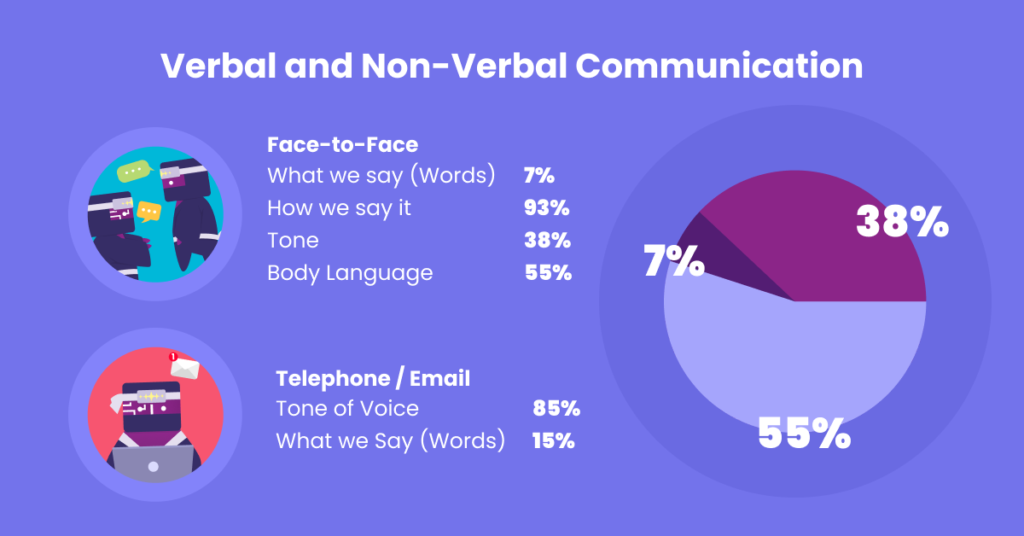
- Watch the non-verbal channel. On voice, tone and pace carry the empathy. In writing, structure carries it: response length, ordering (acknowledgment first), and precision. Both are reviewable.
- Coach it on a cadence. Empathy improves through specific, evidence-based feedback loops, the same coaching rhythm you use for accuracy or process. Kaizo’s coaching cards make this practical by attaching soft-skill feedback to the exact conversations it came from.
How do you measure empathy with quality assurance?
If you can’t measure it, “empathy” stays a poster word. Add two or three empathy criteria to your QA scorecard: acknowledged the issue before solving, matched tone to the situation, used the customer’s context. Our QA checklist has ready-made wording, and scoring those criteria inside your Internal Quality Score makes empathy trends visible per agent and team. Then deal with coverage: empathy failures hide in the conversations nobody reviews, and tone problems cluster in exactly the tickets agents don’t self-report. Automated QA scores soft skills across every conversation instead of a 3-ticket sample, so a lead can coach on the real pattern. For the wider tooling choice, see our guide to QA software.
Build empathy into the team
Individual agents can be naturally empathetic. Teams are empathetic only by design: concrete standards, statements adapted rather than recited, coaching on real conversations, and measurement that notices when tone slips. That’s buildable, and every piece of it also improves the harder metrics, from escalation rate to retention. For the bigger picture, see our 13 strategies to improve customer service.
Frequently asked questions
How do you show empathy in customer service?
Three moves, in order: reflect the customer’s situation back in their own words, acknowledge the emotional cost (“this ate your afternoon”), then state a concrete next action with a time. Understanding, acknowledgment, action.
What are the 5 A’s of empathy in customer service?
Acknowledge the problem, Apologize specifically, Answer the actual question, Act on the fix, and Assure follow-through. Frameworks differ on the words; they agree on the arc.
What are examples of empathy statements?
“You shouldn’t have had to contact us twice about this,” “I’d be frustrated too, let’s fix it,” and “I don’t know yet, but I’ll update you by 3pm” are strong examples: each one names the customer’s reality and commits to an action. See the 50 statements above, organized by situation.
Can empathy be trained?
Yes. Define the observable behaviors, practice on real conversations, coach with specific examples on a schedule, and measure the criteria in QA reviews. Teams treat empathy as innate mostly because they’ve never defined it concretely enough to teach.
What’s the difference between empathy and sympathy in customer service?
Sympathy feels sorry for the customer (“I apologize for the inconvenience”). Empathy understands the customer’s specific situation and shows it (“you lost your Saturday to this”). Customers forgive companies that get it; they leave companies that only apologize.
Want to see how your team’s empathy actually scores across every conversation? Book a demo and bring a tough ticket.