To improve customer satisfaction, find what frustrates customers, fix the biggest cause first and track the one metric that fix should move. The action plan table below pairs ten common problems with an action and a metric to watch.
In short
- Raise satisfaction by fixing the inputs, not by chasing the survey score.
- Effort and friction cause more unhappiness than a lack of delight.
- Give every action one metric, and check it after a quarter.
- Surveys show a sliver, so read the conversations too.
How to improve customer satisfaction: the action plan
Pick the problem your customers complain about most, apply the matching action and watch its metric. Satisfaction is an output, so survey reminders and “please rate us 5 stars” nudges rarely move it for long.
| Problem | Action | Metric to watch |
|---|---|---|
| You guess what customers experience | Map the top contact situations and check the map against real tickets | Repeat-contact rate on the mapped situations |
| Survey comments are too thin to act on | Read conversations, not just survey scores, and tag what caused each contact | Volume of your top contact driver |
| Customers have to work too hard | Cut repeated logins, transfers and asking the same thing twice | Customer Effort Score, repeat contacts |
| Customers wait too long | Fix the slowest outliers first, then the average | First-response time, without a rise in reopens |
| Context gets lost between channels | Carry the history across channels so nobody repeats their story | CSAT gap between channels |
| “No” answers leave customers angry | Explain why and what happens next, instead of a hollow apology | CSAT on “no” or “not yet” tickets |
| Agents chase approvals | Give clear default authority with limits, and audit afterward | Escalation rate, resolution time on exceptions |
| Service quality varies by agent | Coach empathy, clarity and follow-through on real conversations | Coached quality criteria at the next review |
| Good service goes unnoticed | Recognize specific behaviors with real examples | Quality scores and agent engagement |
| Feedback disappears | Route each problem to the team that owns the fix, and tell the customer | Product or process changes traced to feedback each quarter |
Why it is worth it, briefly
McKinsey’s experience-led growth research (2023) describes a company that cut churn by 75% as its satisfaction ratings went from worst to first in its industry. Satisfaction predicts retention, and retention is the cheapest growth there is. The full case is in our guide to the importance of customer satisfaction. This guide is about moving the number. If you are still setting up measurement, start with what CSAT is and how to calculate it.
Lever 1: Know what your customers actually experience
1. Study your customers, not your assumptions
Learn their goals, their friction points and the moments that make or break the experience, from real data rather than intuition. Journey-map the top situations and check the map against what tickets say.

2. Listen to conversations, not just surveys
The strategy most teams skip. A CSAT survey captures the minority who respond, after the fact. Your support conversations hold everyone else, saying exactly what frustrated them in their own words. Manually, read a weekly sample across teams. At scale, conversation analysis surfaces the recurring drivers, so you fix the biggest one instead of guessing. The warning signs are covered in our guide to customer dissatisfaction.
Lever 2: Remove the friction
3. Make it low-effort
Harvard Business Review’s research (2010) found that effort matters more to loyalty than delight: customers leave because you were hard work. Cut the repeated logins, the transfers and the make-them-ask-twice. Reducing effort is usually the highest-return lever.
4. Get faster where it is felt
A fast, human first response buys patience for the rest. Fix your slowest outliers first, because the customer who waited days shapes your reputation more than the average one.
5. Be available on the right channels
Meet customers where they already are, staff those channels to the same standard and carry context across them.
6. Build trust through transparency
When you cannot give customers what they want, tell them why and what happens next. Being open about limits satisfies more than vague reassurance, and trust is what lets a customer stay through a problem.

Lever 3: Empower the team
7. Give agents authority to solve things
Every approval an agent has to chase is a customer waiting on your org chart. Set generous default authority with clear limits and audit afterward.
8. Coach the behaviors that satisfy
Empathy, clarity and follow-through are coachable. Regular customer service coaching tied to real conversations turns the standard into habit. Kaizo builds coaching from quality data, so managers spend their time coaching instead of compiling.
9. Recognize good service
Recognize the behaviors you want more of, tied to real examples. Recognized agents repeat what earned it.

Lever 4: Close the loop
10. Act on feedback, visibly
Collecting feedback is easy. Route each problem to the team that owns the fix, ship the change and tell the customers who reported it. That fixes the root cause instead of re-answering it.
CSAT improvement plan template
A CSAT improvement plan is a one-page document that names the problem, the fix, the owner and the number that proves it worked. Copy this template and fill in one row per action.
| Field | What to fill in | Example |
|---|---|---|
| Baseline | Current CSAT, overall and for the contact reason you are targeting | Overall CSAT and CSAT on delivery questions, last 90 days |
| Top driver | The cause behind most low scores, from conversations and survey comments | Customers chasing late deliveries |
| Action | One change from the action plan above | Proactive delay emails with a new delivery date |
| Owner | One named person | Support ops lead |
| Metric and target | The metric that action should move, with a target | CSAT on delivery questions up, “where is my order” contacts down |
| Review date | When you will check, usually after one quarter | End of Q1 |
| Result | What happened, and the next driver to tackle | Filled in at review |
Keep the plan to three actions at most. More than that and you will not know which one worked.
Measure quality, not just satisfaction
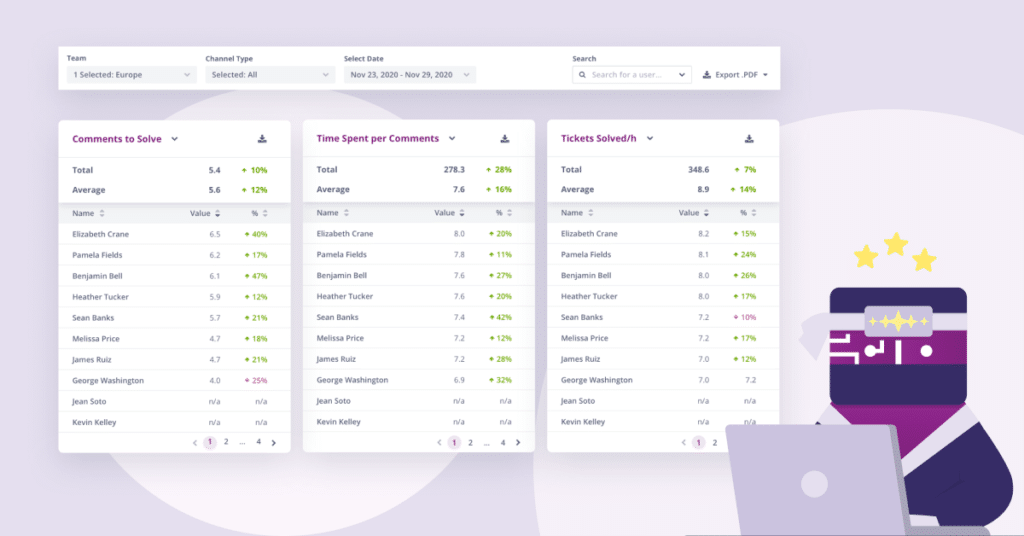
Every strategy above needs proof that it worked, and most teams measure satisfaction through a survey sample and quality through a handful of manually reviewed tickets. Pair CSAT with an Internal Quality Score from our metrics guide: CSAT says how customers felt, IQS says whether your team met its standard. Kaizo’s auto QA scores 100% of conversations against your scorecard, so “did that change work?” stops being an opinion. The problems behind low CSAT often sit in the conversations nobody reviewed. For the evidence on the link, see does QA improve CSAT.
Frequently asked questions
How can you improve customer satisfaction quickly?
Start with effort and speed: remove the most common reason customers have to contact you twice, and fix your slowest response times. These can move CSAT within weeks. Structural changes like coaching cadences and closed feedback loops take one to two quarters.
What is a CSAT improvement plan?
A short plan that sets a CSAT baseline, names the top driver of low scores, assigns one action and one owner to it, and sets a target and review date. Use the template above and limit it to three actions at a time.
What are the 3 C’s of customer satisfaction?
One common version is consistency, consistency, consistency: consistent product, service and communication. Customers calibrate their expectations to your average, so volatility itself dissatisfies.
What is the 10-5-3 rule in customer service?
A hospitality guideline: acknowledge at 10 feet, greet at 5, engage personally at 3. The digital equivalent is graduated acknowledgment: confirm receipt fast, give a real status update quickly and deliver a complete answer within your promised window.
How do you measure whether customer satisfaction improved?
Set a baseline before you start, then track CSAT for the contact reasons you targeted, not just the overall score. Pair it with the specific metric from the action plan and a quality score, so you know whether the change or something else caused the movement.
Pick one lever, measure it, move on
Ten strategies is a menu, not a checklist. Choose the lever where you are weakest, run one strategy, watch its metric for a quarter, then take the next.
If you want to see the satisfaction signals hiding in your own conversations, across 100% of them rather than a survey sample, book a demo.