To improve customer experience, fix the specific moments where your customers’ journey breaks. Understand the real experience, fix the breakpoints such as effort, speed and context, then sustain the gains by coaching behaviors and closing the feedback loop.
In short
- Map the real journey and listen to support conversations, not just surveys.
- Reduce customer effort before you budget for delight.
- Carry context across channels so customers never repeat themselves.
- Measure each fix so you know whether it worked.
Customer experience is the sum of every interaction someone has with your company, from the first ad to the third support ticket. It’s also the metric most companies claim to care about and fewest can actually move, because “improve CX” gets treated as a mood rather than a list of specific, fixable moments.
This guide is the list. Ten actions, grouped by the stage they belong to, each with a way to check whether it worked.
First, why it pays: the business case in one paragraph
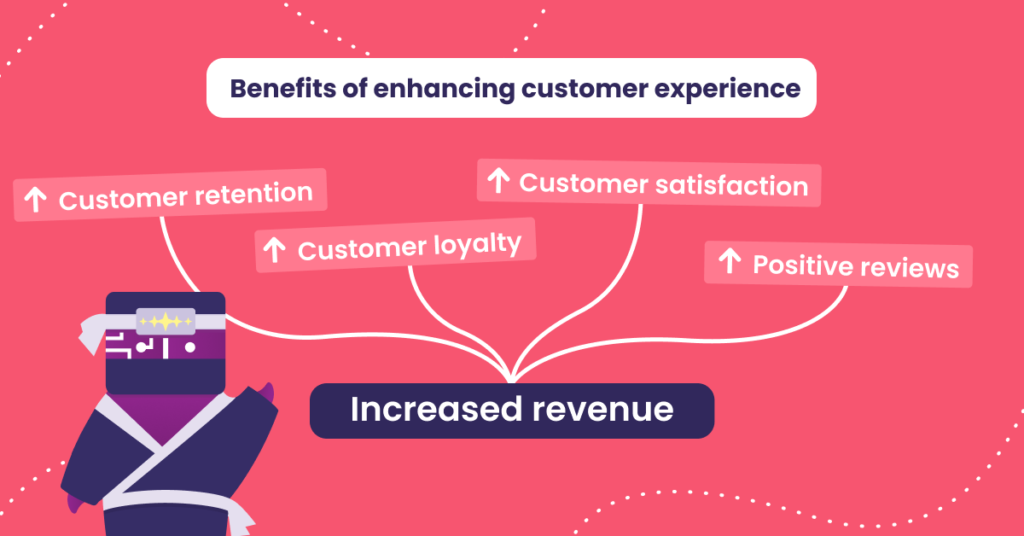
McKinsey’s research on experience-led growth found US customer-experience leaders grew revenue more than twice as fast as laggards between 2016 and 2021. The mechanism is retention: a better experience keeps customers, and kept revenue is cheaper than won revenue. That is why the actions below are worth the effort, and why CX belongs on a P&L conversation, not just a values slide.
Stage 1: Understand the experience you actually deliver
You can’t improve what you haven’t honestly seen. Most CX work fails here, fixing the experience the company designed instead of the one customers live.
1. Map the real journey, not the intended one
Trace your five most common customer situations end to end: where they enter, how often they get transferred, what they already tried before reaching you. The gap between your flowchart and reality is where frustration accumulates. Walk it as a customer would, not as an org chart.
It worked if: you can name the three friction points that generate the most contacts, from data.
2. Listen to conversations, not just surveys
This is where most CX programs quietly go wrong. Surveys reach the 5-10% of customers who respond, and only capture what you thought to ask. The complete record of the experience, every confusion, workaround, and pre-churn signal in the customer’s own words, sits in your support conversations. Manually, that means reading a weekly sample of tickets across teams. At scale, conversation analysis does it structurally: Kaizo clusters 100% of support conversations by what drove them, so “where is CX breaking” becomes a dashboard instead of a guess.
It worked if: you find at least one recurring experience problem that never showed up in survey data.
3. Separate experience data from satisfaction scores
CSAT tells you customers were unhappy; it rarely tells you why. Pair it with the qualitative signal from conversations and the internal-quality view of how your team performed. Our guide to customer service metrics and KPIs covers how these fit together, and how to measure customer satisfaction covers the survey side properly.
It worked if: every CSAT movement can be explained by a specific cause, not guessed at.
Stage 2: Fix the breakpoints
Understanding tells you where to act. These are the levers that move the experience most.
4. Reduce customer effort before adding delight
The influential finding from Harvard Business Review’s customer-effort research: customers stay loyal to companies that are easy to deal with, not ones that dazzle them. Before you budget for surprise-and-delight, remove the friction, the repeated logins, the “please hold”, the third transfer. Making things easy is the highest-ROI CX work there is.
It worked if: your customer effort score rises and repeat-contact rate falls.
5. Get faster where speed is felt
Response time is the part of the experience customers feel most sharply. A fast, human first touch buys patience for everything after it. Fix your slowest outliers first, the tickets that sat for days, because the 90th-percentile wait shapes reputation more than the average.
It worked if: first-response time drops without reopen rate rising.
6. Personalize with context, not gimmicks
Customers don’t expect you to know their life; they expect you not to make them repeat themselves. Carry context across channels and agents so nobody starts from zero. That single change removes one of the most common experience irritations.
It worked if: transfers-per-conversation and “as I said before” moments fall.
7. Meet customers on their channel, done well
Being reachable everywhere is not the same as being good anywhere. Pick the channels your customers actually use, staff them to the same standard, and resist launching a new one you can’t support properly.
It worked if: channel-level satisfaction converges instead of one channel dragging.
8. Improve the employee experience behind the customer experience
The people delivering your CX have their own experience, and it leaks straight through to customers. Empowered, well-coached, non-burnt-out agents deliver better experiences. Give the front line real authority to resolve issues, and coach with evidence rather than pressure.
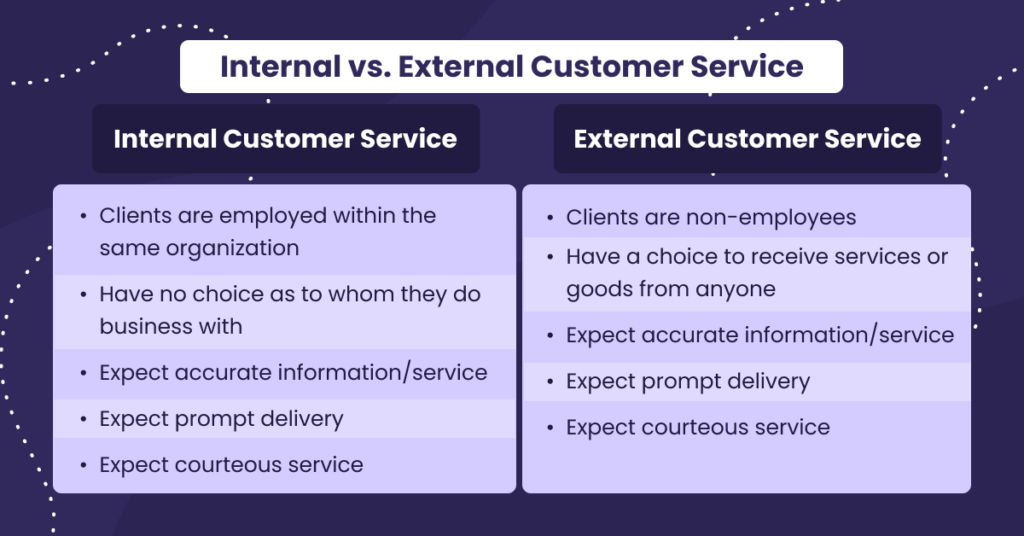
The two audiences share more than most org charts admit: both want to be understood, both respond to being trusted, and both leave when they are not.

It worked if: agent quality scores and CSAT move together over two quarters.
Stage 3: Sustain it
One-off fixes decay. These make improvement continuous.
9. Coach the behaviors that create good experiences
CX is delivered one conversation at a time, and the behaviors that make a conversation good, empathy, acknowledgment, clear next steps, are coachable. Regular customer service coaching tied to real conversations turns a CX standard into daily behavior; Kaizo generates coaching cards from actual quality data so managers coach instead of compiling.
It worked if: the specific behaviors you coach improve at the next quality review.
10. Close the loop, visibly
Feedback that vanishes teaches customers to stop giving it. Route experience problems to the team that owns the fix, ship the change, and tell the customers who reported it. That loop is what separates companies that improve from companies that survey. Our guide to improving customer satisfaction goes deeper on the mechanics.
It worked if: at least one experience fix per quarter traces back to customer feedback, and you can name it.
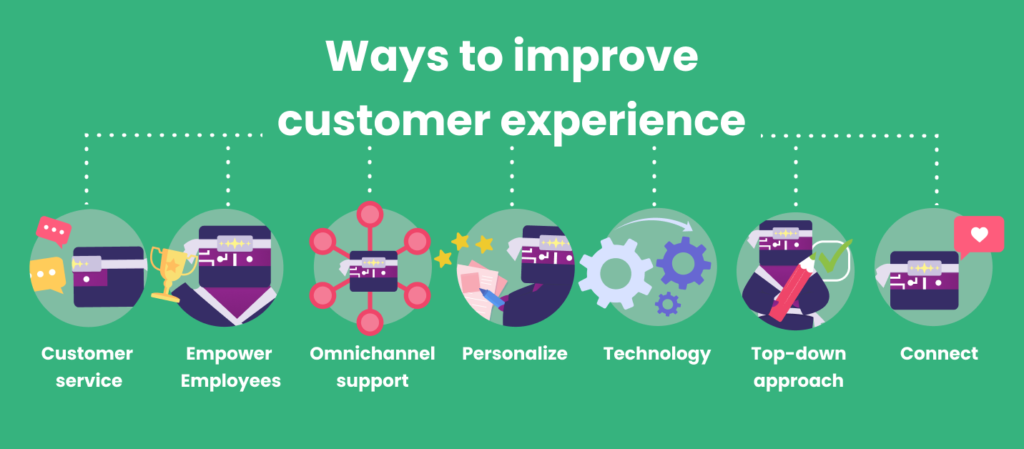
The 10 actions at a glance
| Stage | Action | It worked if |
|---|---|---|
| Understand | Map the real journey | You can name the top three friction points from data |
| Understand | Listen to conversations | You find a problem surveys never showed |
| Understand | Separate experience data from scores | Every CSAT movement has a known cause |
| Fix | Reduce customer effort | Effort score rises, repeat contacts fall |
| Fix | Get faster where speed is felt | First-response time drops, reopens do not rise |
| Fix | Personalize with context | Fewer transfers per conversation |
| Fix | Meet customers on their channel | Channel satisfaction scores converge |
| Fix | Improve employee experience | Agent quality scores and CSAT move together |
| Sustain | Coach the behaviors | Coached behaviors improve at the next review |
| Sustain | Close the loop | One fix per quarter traces back to feedback |
The difference between customer experience and customer service
Quick clarification, because the terms get mixed up. Customer service is one part of the experience: the help you give when something goes wrong. Customer experience is the whole relationship, from marketing and product to pricing and support. Service is where experience problems surface most visibly and cheaply, which is exactly why support conversations are such a rich source of CX intelligence. For the front-line playbook, see our 13 strategies to improve customer service.
Frequently asked questions
How can we improve customer experience?
Work in three stages: understand the real journey (map it and listen to conversations, not just surveys), fix the breakpoints (reduce effort, improve speed, personalize with context, support your employees), and sustain it (coach the behaviors and close the feedback loop). Start with the friction point that generates the most contacts.
What are the 4 P’s of customer experience?
A common framework: People (who delivers it), Process (how it flows), Product (what they buy), and Place/Platform (where it happens). The point is that experience is created across all four, not just in support, so improving it means acting beyond the contact center.
What are the 5 E’s of customer experience?
Entice, Enter, Engage, Exit, and Extend: the five stages of a customer’s journey with a brand. Mapping friction to each stage (Action 1 above) is how the framework becomes useful rather than academic.
What is the difference between customer experience and customer service?
Customer service is the help provided when something goes wrong; customer experience is the entire relationship across marketing, product, pricing, and support. Service is a subset of experience, and the one where experience problems become most visible.
How do you measure customer experience improvement?
Track a paired set: an effort or satisfaction metric (CES, CSAT), a behavioral metric that captures everyone (repeat-contact rate), and the qualitative signal from conversations. A real improvement moves the target metric without degrading the others.
Start where it breaks, not where it’s easy
The temptation is to improve the parts of the experience that are already fine. Resist it. Find the friction point that generates the most contacts, fix that, measure it, and move to the next. Ten actions is a menu; one fixed breakpoint per quarter, verified, beats a CX task force that produces a slide deck.
If you want to see where your customer experience is breaking, across 100% of your support conversations rather than a survey sample, book a demo and bring your messiest queue.