Kaizo vs EvaluAgent
The Kaizo alternative to EvaluAgent
EvaluAgent gets the part most QA tools get wrong: agents like it. The gap is upstream and downstream, setup going in, and finding your numbers coming out.
Last reviewed August 2026
Trusted by global support teams











The short version
EvaluAgent is genuinely good at the part most QA tools get wrong: agents like it. Auctions, auto queues and the ability to query a score make QA feel fair rather than punitive, and we would not argue with any of that. The gap their own reviewers describe is upstream and downstream of it: scorecard design and initial configuration take time, clarity and possibly external support; the numbers you want sit behind a filter you reset every login; and a review notification arrives without telling the agent the result.
Kaizo and EvaluAgent, feature by feature
Every row states the reason, not just a verdict.
| Capability | Kaizo | EvaluAgent |
|---|---|---|
| Coverage and automation | ||
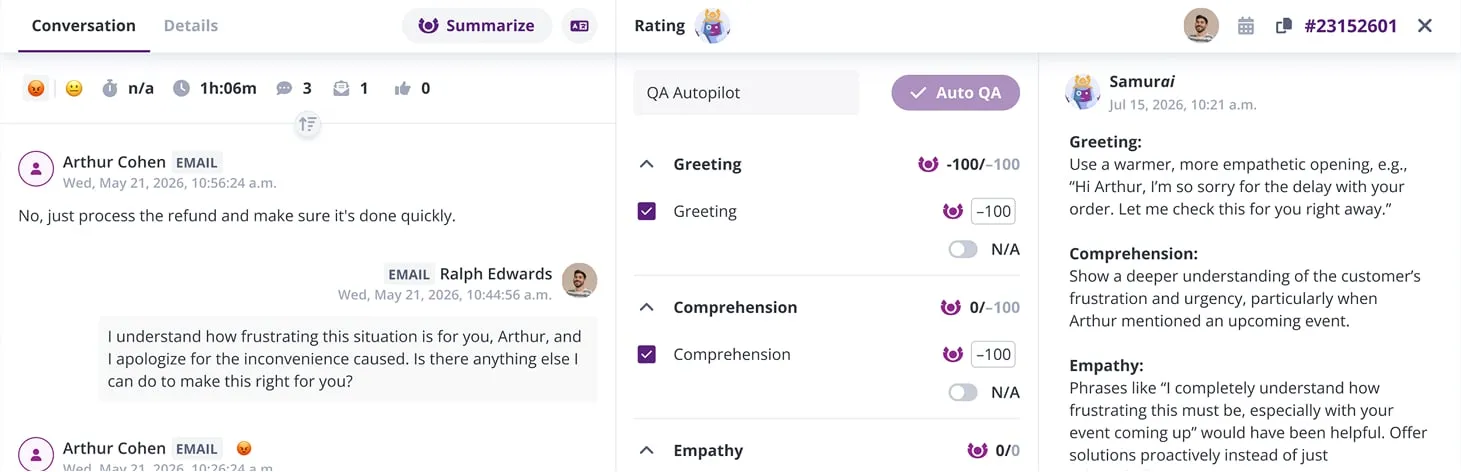
| Automatic scoring of every conversation | Yes AutoPilot scores 100% of conversations against your own scorecard, with no sampling and no reviewer queue. | Yes Credit where it is due. Reviewers say it solves the limited visibility of QA sampling and cuts time spent on manual reviews. |
| Always-on, hands-off mode | Yes AutoPilot keeps scoring continuously in the background. Nobody has to start a review cycle. | Partial Auto queues assign work fairly and reviewers value exactly that. It still routes conversations to an evaluator rather than removing the queue. |
| Coaching generated per agent | Yes AI coaching cards are written per agent from their own conversations. EverHelp cut coaching prep by 75% across 16 domains. | Partial Sessions and plans keep agent progress in one place and reviewers rate them. The analysis and the write-up stay with the manager. |
| Insight and reporting | ||
| Your current numbers in front of you by default | Yes Coverage, quality trends and coaching impact are the default view, not a filter you rebuild every morning. | Partial Filtering friction is a top complaint tag. One reviewer manually re-filters for the current month at every login; another cannot easily find reviews from a specific day. |
| Reporting depth without a BI project | Yes Coverage, quality trends and coaching impact report natively, out of the box. | Partial The data is there, but reviewers describe having to work to get to the view they wanted. |
| Agent experience | ||
| Agents can challenge a score they disagree with | Yes Every score links to the evidence in the transcript, so a disagreement is settled by reading rather than arguing. | Yes Querying a score is one of the things their reviewers most appreciate, and it is a genuine strength. |
| Agents see the result when they are notified | Yes The coaching card carries the score, the reason and the linked conversation together. | No Reviewers report a review notification arrives without telling the agent the outcome. |
| Time and effort | ||
| Time to implement | Days Connect the helpdesk, define a scorecard, switch on Autopilot. | Setup-heavy Reviewers say scorecard design and initial configuration take time, clarity and possibly external support. |
Competitor detail is drawn from public G2 reviews and verified buyer data, current as of July 2026. If something here is out of date, tell us and we will correct it.
Where the two tools actually differ
This is the closest comparison in the category, and the honest answer is that EvaluAgent does something genuinely well that most QA tools get wrong: it makes QA feel fair to the people being reviewed. Auctions, auto queues and the ability to query a score are real strengths, and we would not pretend otherwise.
The gap sits on either side of that. Getting set up takes configuration work their own reviewers describe as needing time and sometimes outside help. And once running, the numbers you want are behind filters that reset. A small friction that compounds when you look every day.
What changes
Kaizo removes the queue rather than routing it, writes the coaching card instead of leaving the write-up with the manager, and puts current coverage and trends on screen by default. Agents get the score, the reason and the conversation in one place rather than a notification that a review happened.
The migration
Your criteria come with you, and your historical ratings become the test set for verifying the AI before it scores anything live.
Teams that made the switch
-
50%
less QA time
“Our tickets can be long and complex. AI has been a life-saver in our experience.”
SteelSeries
-
75%
faster resolution
“Kaizo is an essential part of finding the root causes of areas we need to improve, then improving on that.”
Foot Locker
FAQ
Frequently asked questions
Can we migrate from EvaluAgent without losing our history?
Yes. Your scorecards map across, and your historical ratings are useful to us. We use them to verify the AI matches your standards before it scores anything live.
How long does switching take?
Days. Once the rubric is set and your helpdesk is connected, AutoPilot starts scoring immediately.
Is this comparison fair?
It is compiled from EvaluAgent's public documentation and pricing. Vendors change what they offer, so if something here is out of date, tell us and we will correct it.

See what EvaluAgent is not scoring
We will run Kaizo across a sample of your real conversations, so you can compare the coverage rather than the feature list.
Trusted by global support teams