Customer service coaching is the ongoing practice of helping every agent improve through regular feedback, one-to-ones and coachable moments taken from real conversations. Unlike training, it never ends, and it works best when it is built on QA data instead of gut feeling.
In short
- Training has an end date, coaching is continuous.
- Most agents want regular feedback, and very few want none at all.
- Coach every agent, not only the top and bottom performers.
- Use QA data to find coachable moments and track progress.
The bar of customer service expectations keeps rising. A 2017 report by Microsoft revealed that 54% of consumers have higher customer service expectations than they did one year ago. And if you look at a specific age group, people from 18 to 34 years old, aka the most active age group online, that number is as high as 66%.
With those numbers comes the added pressure to reinvent the approach to performance management. This is why many high-performing service leaders have already adopted a culture of performance coaching.
What is customer service coaching?
Customer service coaching, otherwise known as performance coaching, is a lifestyle at the workplace. It’s not just a training program for agents to grow within their roles. In its essence, customer service coaching is a type of performance management that puts training at its very core. It is that building block you repeatedly use as you try to reach your goal, customer loyalty. But it’s the journey that matters, not the destination, right?
In other words, coaching customer service is an ongoing process. It is a give and take where you use all the tools and data at your disposal to analyze your team’s progress and give agents actionable feedback on their performance, while also being open to their feedback.
Kaizo’s survey of more than 250 support agents found that 45% of agents want to get one performance feedback session every month and only 6% said they want no feedback at all. The same survey found that 73% of agents would like more autonomy in their role, while 1 in 4 said they are still being micromanaged. That’s another proof of the claim that continuous growth asks for a culture of coaching to drive your management style. Coaching does not end with onboarding. Instead, it functions as the driving force in every agent’s journey up the customer support ladder.
Now, in many cases, customer support leaders aim for their agents to provide service that is personal, prompt, and precise. And although that is good enough, prescient customer support is the goal you want to chase. In this context, “prescient” means that you answer questions before they even occur to a customer; you brainstorm potential issues and find solutions to them before a customer gets to experience them.
By continuously using customer service coaching techniques you can teach your agents to understand and predict customer wants and needs. That, in the end, is the way to reach prescient customer service.
Customer service training vs. customer service coaching
Customer service quality coaching is not the same as training, even though many people use them interchangeably in customer service. The simplest way to put it is this: training has an expiration date, it is a short-term project. Onboarding, upskilling your agents, giving them a baseline of knowledge or a quality assurance checklist to follow are among them.
Coaching customer service reps, doing continuous performance coaching, is a larger idea. It is an approach to management. Customer service training is a constituent part of the culture of coaching, not the other way around. This culture includes 1:1 sessions driven by data and transparency, not gut feeling. It’s about giving agents timely feedback and actionable advice no matter how good they get at the job. With performance coaching, you don’t just focus on the top performers or those who trail behind. You coach every individual.
| Training | Coaching | |
|---|---|---|
| Duration | Short-term project with an end date | Ongoing, part of how you manage |
| Who gets it | New starters, or everyone when something changes | Every agent, every month |
| Based on | A curriculum or checklist | The agent’s own conversations and QA scores |
| Format | Courses, sessions, documentation | One-to-ones, micro-coaching, feedback on real tickets |
| Goal | A baseline of knowledge | Continuous improvement and career growth |
Why is customer service coaching important?
A good and well-trained agent can give your customer a good experience. But only an agent who grows in a culture of coaching can turn a customer into a brand advocate. A true blue fan who will increase your NPS.
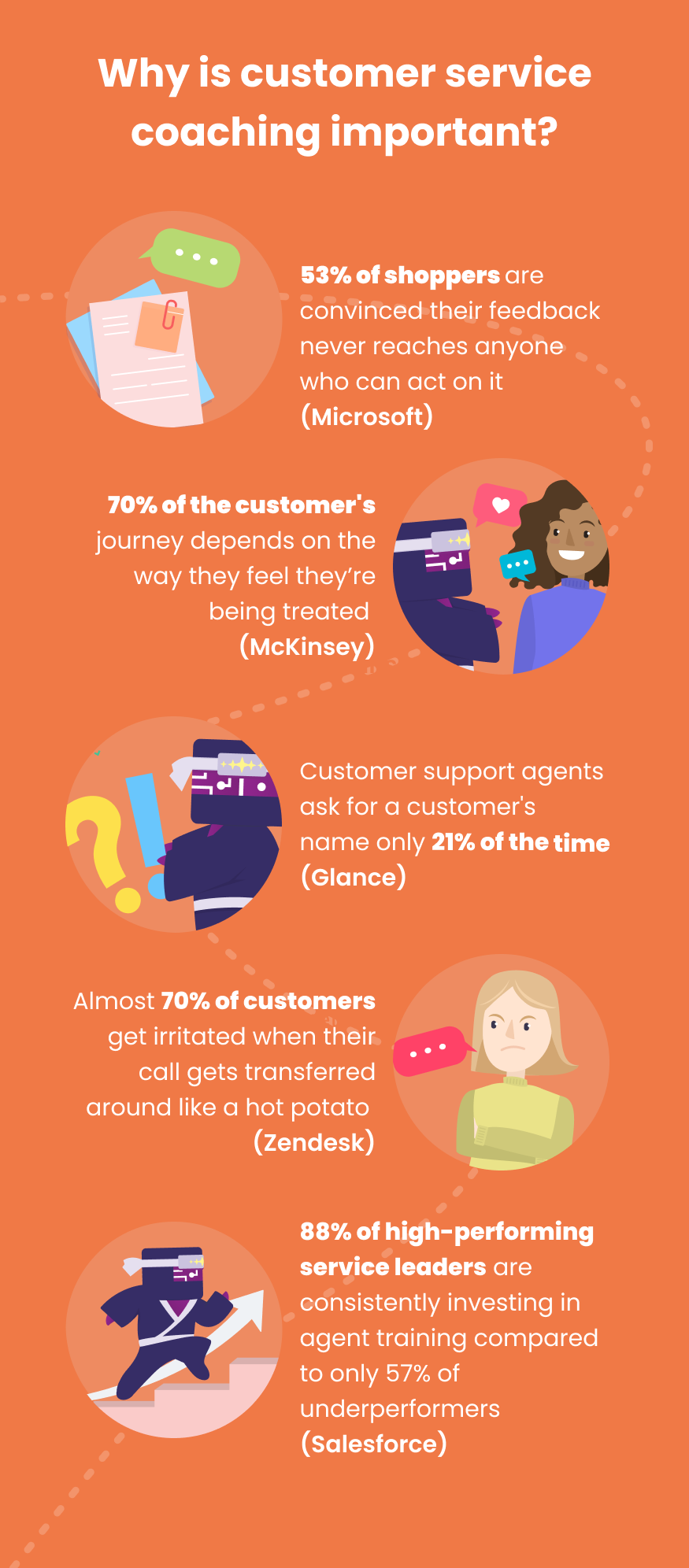
Numbers speak louder than words, so let’s look at a few numbers that indicate the importance of continuous performance coaching in customer service.
-
Retaining an existing customer is 6-7 times cheaper than attracting a new one.
-
In Microsoft’s 2017 report, 72% of consumers expect that your agents already know who they are, what they bought, and have an understanding of their engagement with the company.
-
70% of the customer’s journey depends on the way they feel they’re being treated.
-
In Zendesk’s 2020 CX Trends report, almost 70% of customers get irritated when their call gets transferred around like a hot potato.
-
88% of high-performing service leaders are consistently investing in agent training compared to only 57% of underperformers.
The three problems coaching solves
When we interviewed support leaders about what gets in the way of performance, the same three problems came up again and again, and continuous coaching is the answer to all of them:
- Team performance. Leaders spend hours trying to work out how to lift performance without a clear plan, lose focus across too many metrics, and coach only the top and bottom performers instead of every individual.
- Agent churn. Teams train new agents for months only to lose them within a year, often because there is no visible career path and no system for recognising good work.
- Operational inefficiency. Leads end up managing processes instead of people, comparing metrics across spreadsheets rather than coaching from them.
So, what do you do to adopt this culture of coaching? Here’s where you start.
How to do coaching in customer service?
One way or another, customer service coaching is a philosophy, an approach to the way you do customer service. And since it is a philosophy, and not a standalone customer service coaching program, there are lots of steps you need to take to reach considerably higher performance outcomes.
Hire right
During one of our webinars, customer support experts shared a tip that is crucial not only when you coach customer service people, but when you look to retain your talent too.
For each customer service coaching session to be successful, hire people who are fit to work in customer service.
Every job in customer service requires a good set of soft skills and interest in the success of the brand. You’re selling it, after all. But if these things are fairly intuitive in recruitment, there’s something many leaders have been missing, plans to build a long-term career in customer service. To put it another way, it’s crucial to make sure the person you are hiring doesn’t look at customer service as a “seasonal” job (and neither should you, seasonal hiring costs companies more than you think).
Invest in career development
Once you find the right talent, make an effort to keep it in the house. In many cases, employers suffer from high employee churn in customer service because their agents do not see a future at the company, don’t have that sense of belonging to the larger picture. Developing your agents’ careers, challenging them on a daily basis, and working out a plan for them to climb up the corporate ladder within the company is a sure way to retain talent.
But it’s not just career development that should be included in all customer service coaching templates. It’s also rewarding and recognizing your agents for their effort. After all, feeling appreciated is something every person craves in their personal life as well as at the workplace.
Identify coachable moments
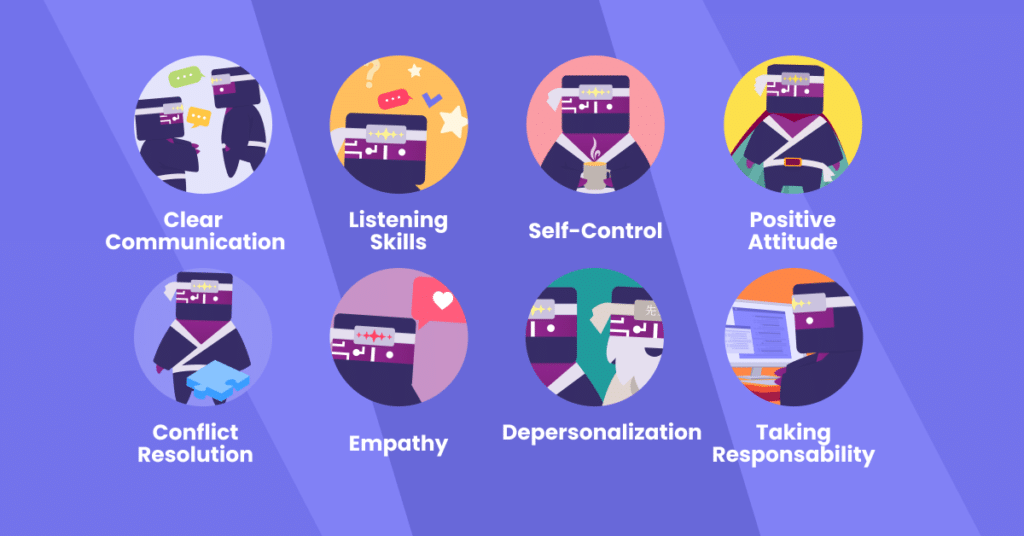
As a part of your daily efforts to make performance coaching work, be sure to help your people grow by identifying coachable moments and acting upon them. Spotting those learning opportunities and defining a plan of action to get from point A to point B will help you empower your agents for continuous growth.
For example, a specific metric, like customer satisfaction ( CSAT), might indicate that you need to focus on coaching soft skills in your agents. It could be anything from active listening and communication to conflict resolution and empathy.
If there is a real success story that proves just how valuable this coaching mindset can be, it would have to be this one.
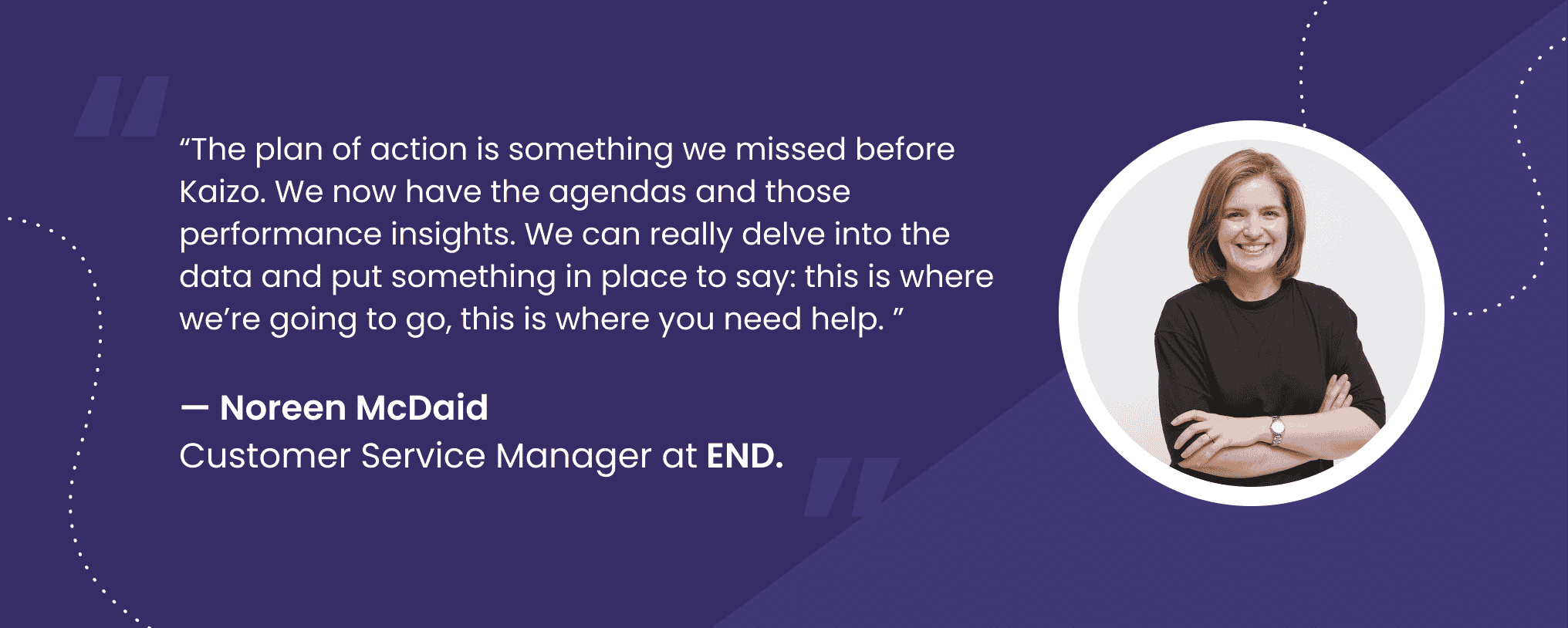
END., a fashion retailer from the UK, made it their goal to build a team that would work like a well-oiled machine. And so they did, using Kaizo’s performance insights and Missions, which help them pinpoint learning opportunities, set goals, give guidance and continuous support to their Agents. After months of hard work and consistent coaching they were ready to admit this:
“The team that we’ve got at the moment is one of the best customer service teams we’ve ever had.”
Read more: How END. built their best support team ever
Do micro-coaching on a daily basis
It’s a common misconception that coaching customer service agents is something you do once per quarter, or even once per year, that the “coaching” in coaching agents means “telling” them ways they could improve. While it’s true that some coaching involves telling your agents what to do, there are many other forms of coaching that are just as important, and often more effective.
Micro-coaching, for example, is a form of continuous coaching that can happen whenever you observe an agent who needs a little help in the moment, or for any agent at any time throughout the day. Micro-coaching is about having the right agent tools available so your agents can quickly overcome challenges and be empowered to take on new opportunities.
Rely on individual performance data
Coaching also means using performance data to understand how well each agent is handling their calls. It’s important to point out good behaviors as well as bad ones, because positive reinforcement motivates agents to keep doing what they’re doing well. In addition, it’s important to recognize when new information becomes available that changes how an agent must handle a call, so he or she will be prepared for future similar calls and won’t have to go through the same process of learning anew.
It is also about keeping the lines of communication open. It’s important for managers to be able to talk with agents, especially when their performance isn’t up to par. This doesn’t mean berating them for doing something wrong; rather, it means helping them understand how they can do things better.
Get a performance coaching tool to automate processes
One of the hardest things about being a customer support leader is that you can easily get stuck in numbers and end up “coaching” numbers, instead of people. There are lots of metrics driving customer support and if you keep all of that data in spreadsheets, sooner or later, it will get tangled. Luckily, it is easy to automate all of these processes and get real-time data without having to jump from one Excel file to another.
Learning how to coach a customer service representative is not something that happens overnight, but once you have a solid plan of action on the table, getting all performance outcomes up will be a matter of time. To see how you can adopt that culture of coaching with Kaizo, see Kaizo AI coaching or book a demo.
Frequently asked questions
How often should you coach customer service agents?
Hold a structured one-to-one at least once a month and add micro-coaching in between, whenever you spot a coachable moment. In Kaizo’s agent survey, 45% of agents asked for a feedback session every month. Waiting for a quarterly review means feedback arrives long after the conversation it is about.
What should a customer service coaching session include?
One or two specific behaviors, real conversations that show them and an agreed next step. Start with what the agent did well, then pick the one change that would make the biggest difference. Close by agreeing how you will both know it worked.
How do you know if coaching is working?
Track the behavior you coached in the agent’s QA scores over the following weeks, alongside CSAT and repeat contacts. If the scores on that criterion rise and stay up, the coaching landed. If not, change the approach rather than repeating the same feedback.