A customer service quality assurance checklist is a short list of things every support conversation should get right, grouped into solution, tone and efficiency, each with a clear standard and a score. The tables below are a complete checklist you can copy into your scorecard.
In short
- Score every conversation on solution, empathy and tone, and efficiency.
- Write down what good looks like for each item, or reviewers will disagree.
- Weight items by risk: a wrong answer costs more than a typo.
- Review the checklist every quarter so it matches your product and policies.
What is a customer service quality assurance checklist?
It is the list of criteria your reviewers use to grade support conversations, with a definition of “good” and a scoring rule for each one. It turns “was this a good reply?” into questions two reviewers can answer the same way.
The hardest part of setting up a customer service QA program is usually this first step: deciding what quality means for your team. There is no single correct answer. A checklist built for a software help desk will look different from one for a retailer or a bank, because the products, the risks and the customers differ. Start from the template below and cut or add items until it fits.
Why you need a QA checklist
A checklist standardises how you review calls, chats and emails. Without one, every reviewer grades on gut feel, agents get contradictory feedback and the scores mean little. Voice teams can start from our call center QA checklist.
With one, you can:
- Spot problem areas in your service process, not just in individual replies.
- Show new agents exactly what is expected of them.
- Find patterns: the same item failing across a whole team usually points to a training gap or a broken process.
- Give coaching a concrete starting point instead of a vague “be more empathetic”.
The customer service QA checklist
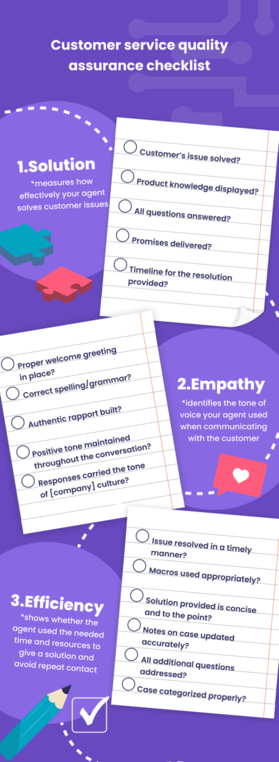
The checklist has three categories. Each item has a standard and a suggested way to score it. Use Yes / No / N/A where the item either happened or did not, and a 0 to 2 scale (missed, partly, fully) where quality varies.
1. Solution
The most important category: did the agent actually solve the customer’s problem?
| Item | What good looks like | How to score it |
|---|---|---|
| Solved the customer’s issue | The issue is fixed, or the customer knows exactly what happens next | Yes / No, highest weight. Many teams make a No an auto-fail |
| Gave alternatives when needed | When the answer is “no”, the agent offers a workable option | Yes / No / N/A |
| Showed product knowledge | Accurate answer, no guessing, correct help article linked | 0 to 2: wrong, partly right, fully right |
| Answered every question | Every question gets a reply, including the one buried in the last line | Yes / No |
| Gave a timeline | The customer knows when to expect the fix or the next update | Yes / No / N/A |
| Encouraged self-service | Points to the article or setting so the customer can do it alone next time | Yes / No / N/A, low weight |
| Kept promises | Any promised update or callback happened on time | Yes / No. Check the ticket history, not just the last reply |
2. Empathy and tone
An agent’s ability to show empathy and use the right tone can be the difference between a good review and a bad one. Scoring it separately shows exactly where an agent can improve.
| Item | What good looks like | How to score it |
|---|---|---|
| Greeting | A greeting that fits the channel, using the customer’s name | Yes / No, low weight |
| Brand tone | Reads like your company, as described in your tone-of-voice guide | 0 to 2 |
| Positive tone throughout | Stays calm and friendly, also when the customer is not | 0 to 2 |
| Spelling and grammar | No errors that change the meaning or look careless | Yes / No, or deduct per error up to a cap |
| Took the lead | Sets out the next steps instead of waiting for the customer to ask | Yes / No |
| Empathy and apology | Acknowledges the impact in plain words and apologises when the company is at fault | 0 to 2 |
| Built trust | The customer ends the conversation confident in the answer | 0 to 2 |
| Emojis and GIFs | Used only where your brand allows it and the mood fits | Yes / No / N/A |
| Closing | Thanks the customer and offers further help | Yes / No, low weight |
3. Efficiency
Efficiency is about more than speed. It means using time and tools well enough to solve the issue once and avoid a repeat contact.
| Item | What good looks like | How to score it |
|---|---|---|
| Resolved in good time | Resolved within your target for this contact type | Yes / No against your SLA |
| Used macros well | Macro used where it fits, then edited to answer this customer | Yes / No / N/A |
| Concise | The answer is short and complete, with no wall of text | 0 to 2 |
| Accurate notes | A colleague could pick up the case from the notes without rereading the thread | Yes / No |
| Correct categorisation | Tags and fields set correctly, so reporting holds up | Yes / No |
| Prevented a follow-up | Anticipated the obvious next question and answered it | Yes / No / N/A |
Download the checklist
Want it as a file you can share with your reviewers? The customer service quality assurance checklist e-book is the free downloadable version. To run it as a live, weighted scorecard instead of a document, see Kaizo Scorecards.
How to score the checklist
A checklist only helps if you can measure with it. Focus on two things.
Internal scoring
Give each item points and a weight, so the score reflects what matters. For example, spelling and grammar might be worth 10 of the 50 points in the empathy and tone category, while “solved the issue” carries far more weight than the greeting. The result per conversation is your Internal Quality Score, and it makes coaching needs easy to pinpoint.
Before you roll it out, have two or three reviewers score the same ten conversations. Where they disagree, the “what good looks like” column needs rewriting.
Quality metrics
Next, check whether the checklist is improving results, using a performance metrics scorecard. Track:
- Customer Satisfaction Score (CSAT): how satisfied the customer was with the solution, usually as a percentage.
- Net Promoter Score (NPS): the answer, from 0 to 10, to “How likely is it that you would recommend us to a friend or colleague?”
- Negative Response Rate (NRR): negative ratings an agent or team receives compared with positive ones, as a percentage.
- First Contact Resolution (FCR): the percentage of requests resolved in the first contact.
- Repeat Contact Rate (RCR): the percentage of solved tickets reopened because the issue was not fixed.
If QA scores rise and these metrics do not move, your checklist is measuring the wrong things.
Applying the checklist to every conversation
Most teams review a few conversations per agent per week, so the checklist describes a small sample. Quiet failures, like a promise nobody kept, rarely make it into that sample. With auto QA, Kaizo scores 100% of conversations against your own scorecard, so the checklist applies to every ticket instead of a handful. Reviewers then spend their time on calibration and on the conversations that failed.
Make it your own
Every support team defines quality a little differently. Treat this checklist as a starting point. Drop items that never fail, add the ones your customers complain about, and revisit the list whenever your product, policies or channels change.
Frequently asked questions
What should be on a customer service QA checklist?
Items in three groups: solution (did the agent solve the issue, accurately and completely), empathy and tone (greeting, brand voice, empathy, spelling) and efficiency (speed, notes, categorisation, preventing a follow-up). Each item needs a written standard so reviewers score it the same way.
How do you score a customer service QA checklist?
Use Yes / No / N/A for items that either happened or did not, and a 0 to 2 scale for items where quality varies. Weight the items by risk, so a wrong answer costs more than a missing greeting. Add the points into a percentage per conversation.
What is the difference between a QA checklist and a QA scorecard?
The checklist is the list of criteria. The QA scorecard is the checklist with weights, scoring rules and auto-fails attached, used to grade each conversation. In practice most teams build the checklist first and turn it into a scorecard.
How often should you update your QA checklist?
Review it every quarter, and whenever you launch a product, change a policy or add a channel. Remove items every agent passes every time, because they add work without telling you anything.
Is there a free customer service QA checklist template?
Yes. Copy the tables above, or download the customer service quality assurance checklist e-book for a version you can share with your team.
Turn this checklist into a working scorecard
Bring your current criteria and a week of conversations. We will show you which checks hold up in review, which ones your reviewers disagree on, and which to drop.