Respond to a bad customer service review quickly and publicly: apologize, own what went wrong and move the fix to a private channel. Then treat the review as QA data and find out why it happened, so the next customer does not write the same one.
In short
- Reply fast, in public, and take the detail private.
- Separate what the agent controlled from what they did not.
- Group negative reviews by cause to find the real problem.
- Fix the process or product, then coach the agent.
Raise your hand if you like bad customer service reviews? No one? If you asked 10 customer service managers to write down which KPI is most important for their team, at least 9 would mention customer satisfaction (CSAT). If you don’t believe me, just Google ‘most important customer service KPI’s’ click any listicle, and… voila!
It’s unanimous, and rightfully so. However, CSAT steals all the limelight, there is another, less documented KPI that arguably provides a more constructive window into how customers perceive your service.
Negative Response Rate (NRR). The quantified accumulation of your bad customer service reviews. If measured and utilized correctly, these negative customer reviews can be the key to improving all aspects of your team’s performance. From employee engagement.
We chatted with customer service leaders from Zendesk, Marleyspoon, and Fetchpackage about why bad customer service reviews are the key to drastically improving your team from the bottom up.
How do you respond to a bad customer service review?
Thank the customer, apologize for the specific problem, say what you are doing about it and offer a direct way to continue the conversation. Keep it short, skip the template language, and never argue in public.
What you say depends on what went wrong, and so does what you fix afterwards:
| Situation | What to say | What to fix |
|---|---|---|
| Slow reply or long wait | Apologize for the wait and give a realistic time for the answer | Staffing, routing or SLA targets for that channel |
| Agent gave wrong information | Correct it plainly and apologize for the confusion | Knowledge base article, then coach the agent |
| Rude or dismissive tone | Apologize without excuses and offer a direct contact | Tone criteria on your scorecard, and coaching |
| Product fault or bad delivery | Acknowledge it, explain the fix or replacement | Send the pattern to the product or logistics team |
| Customer disagrees with a policy | Explain the reason briefly and offer any option you can | Check whether the policy or how it is explained causes repeat complaints |
| Review breaks the platform’s rules | Reply calmly once, then report it | Nothing internal, but log it so it does not skew your numbers |
The reply handles one customer. The fix stops the next review.
What is a Negative Response Rate?
Negative Response Rate (NRR), also known as DSAT or BADSAT, is a customer support metric measuring the number of negative customer reviews an agent/team receives vs positive reviews as a percentage.
It is the inverse of an agent’s CSAT score (e.g. if an agent’s weekly CSAT score is 60%, their NRR will be 40%).
* For Zendesk users, bad customer service reviews are referred to as bad ratings*
How to calculate NRR
Negative Response Rates are a key indicator of customer dissatisfaction and a tool for improvement. As a result, many managers/QA leads undergo the time-consuming process of calculating the rate manually.
This involves sifting through each bad and good customer service review left for each agent. Managers must then organize these numbers into a spreadsheet and manually calculating the rate based on the formula:
NRR= negative customer reviews ÷ all customer reviews .
To save teams hours on these tedious processes, Kaizo calculates the metric automatically for each agent in real-time and displays it alongside their CSAT score in their personal Scorecard.
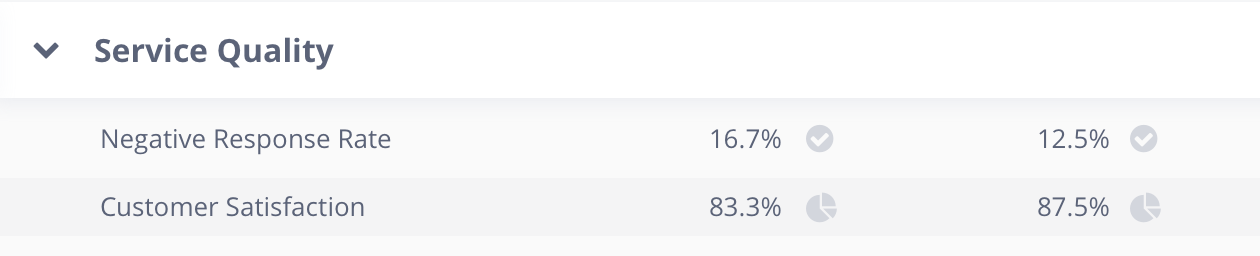
The Scorecard allows you to drill-in into these metrics to see and evaluate exactly which negative customer reviews contributed to your NRR.
Whether it’s for 1:1 performance meetings, your quarterly business review, or a product feedback session, all team members are up to speed with easy access to real-time metrics and negative review transcripts, all in one place. Making it easier than ever to utilize these bad customer service reviews to improve your team’s performance.
Why bad customer service reviews are the key to improvement
Some of the best lessons we learn in life are from our mistakes and failures.
Bad customer service reviews may seem like a loss for your team. However, they are actually the key to developing all aspects of your service. Beyond that, they are the key to optimizing how your company operates as a whole.
It is undeniable that positive CSAT responses are valuable for validating your support or product/service. Although, what they don’t do, is provide constructive criticism from which your team can grow.
On the contrary, negative reviews provide a window into the unbiased, honest perceptions of your customers. In turn, this gives valuable feedback on your product and the quality of your customer service.
These insights allow your team to:
- Improve internal processes, product/service, and agent performance
- Ensure long-lasting customer retention
- Revamp employee motivation and engagement
How to utilize bad customer service reviews for improvement
Naturally, when it comes to negative reviews the goal is to have as few as possible. This ensures that your customers are ultimately satisfied.
However, no matter how perfect your product/service and support are, there will always be select customers who are unhappy with the way you operate.
It’s what you do with these negative customer reviews that really matters.
Something to keep in mind when utilizing your bad customer service reviews is that they can be used to identify both smaller problems and larger-scale issues. This is what Holly Vande Walle, Director of Training and Quality Assurance at Zendesk refers to as real-time and root-cause reviews.
- Real-time review: A manager/team lead reviewing an agent’s negative customer review within 24 hours to assess whether it was actionable or non-actionable.
- Actionable rating: When the customer’s dissatisfaction is outside of an agent’s control. E.g: product malfunction or untimely delivery.
- Non- actionable rating: When the customer’s dissatisfaction is the direct fault of the agent. E.g: lack of product knowledge, not resolving an issue.
- Root-cause review: Weekly/quarterly collecting all the previous negative reviews to identify trends and what is causing them. This means looking at reasons (e.g: product knowledge) and channels (e.g: chat has the highest satisfaction rate) to pinpoint areas that need coaching.
The root-cause review is where most teams get stuck, because reading every negative review by hand does not scale. Kaizo Insights shows what is actually causing dissatisfaction across every conversation, and separates systemic problems from individual ones, so you know whether to fix a process or coach an agent.
“It’s important to not only look at BADSAT in a vacuum. We need to take a step back and see the ebbs and flows of it alongside other business metrics to identify performance trends”
Holly Vande Walle, Director of Training and Quality Assurance at Zendesk
Here are a few ways your team can utilize your bad customer service reviews for overall improvement.
Improving processes, product feedback, and agent performance
For any business, the key to continually developing and improving is quality customer feedback.
Analyzing and acting upon negative customer reviews allows teams to improve their customer experience from the inside out.
Internal Processes
Even if your team has a strong management structure and operationally efficient tools, there can often be small gaps in your internal processes that contribute negatively to your customer experience.
The key to getting feedback on your processes is simple, ask for it. Be proactive and don’t be afraid to receive negative responses because they will shape your process development.
“W e proactively ask our customers to leave feedback, then categorize our negative responses into issue codes [tags]. We then report these to the relevant departments and work together to identify root causes and bottlenecks in our process and work on improving them immediately”
Charles Damore, Customer Communications Supervisor at Marleyspoon
Tips
- Be proactive. 71% of consumers say that they would leave a review for a business when asked. So ask customers specific questions about their satisfaction to identify which parts of your process you think may need improvement.
- Hold monthly and quarterly business reviews with your operations team. Use these to go over negative reviews and construct actionable steps to developing your process. Continue this process to analyze whether the changes you make result in a decrease in negative customer reviews.
Product Feedback
Oftentimes, bad customer service reviews aren’t focused on the level of service your team is providing. Rather, they give critical feedback on the product/service your company supplies.
These responses can be used to create an actionable product feedback loop between your service and product teams.
“Some of our most common [negative] responses are from customers who are unhappy with a certain ingredient in one of our meals. Once we detect a trend in these responses, we address it with the product team in the monthly business review and adjust it accordingly”
Charles Damore, Customer Communications Supervisor at Marleyspoon

Tips
-
Use ticket tags to categorize negative responses. Use the tag #product_feedback to organize all relevant tickets that should be shared with the product team.
-
Create a Slack channel called #product_responses. Any time an agent receives negative responses about the product they can post them here. Managers can then assess what needs to be pushed into the feedback loop.
-
Hold weekly meetings to discuss these negative responses with your support team. Analyze the results to see if there are any trends. Then share these with the product team. E.g. receiving 100 tickets last week about changing a certain feature.
Agent Performance/Service Quality
Whether it’s providing incorrect information, not apologizing for a late response, or using an unwelcoming tone of voice, an agent’s service quality is one of the prime catalysts for negative customer reviews.
Whilst these instances reflect poorly on your company, they are also opportunities to analyze and act upon areas that agents need to improve on.
“If I get a negative reply about an agent, I use this as a retraining opportunity and put aside time for 1:1 meetings. This ensures each agent is educated and has the resources to provide the level of service the customer expects”
Sophia Spagnuolo, QA lead at Fetchpackage
Tips
- Set NRR as one of your team’s main KPI’s with incentives for those who achieve the lowest scores each month. This will spark a dramatic increase in service quality as agents are more motivated to achieve their team goals.
- Each week, categorize aspects of your agents’ performance that are causing negative reviews (e.g- tone of voice). Add this as part of your QA criteria. Rather than entering and analyzing this data manually ditch your spreadsheets. Let Kaizo’s customizable QA system crunch the numbers for you.
- Cross-reference negative trends in an agent’s customer ratings with their QA to pinpoint coaching areas. E.g: Agent A has received 4 negative ratings for lack of product knowledge and has seen a drop in their score for the same reason. This identifies an exact area that needs improvement.
- Incentivize your agents to improve in these focus areas with weekly rewards for those that provide high-quality answers based on your team’s quality criteria.
Customer Retention
Handling negative responses is make or break time in ensuring you retain a customer or lose them for life.
In a highly competitive market, focusing on the quality of your responses to negative feedback, rather than speed and quantity, is the key to ensuring your customers don’t churn.

“As a startup, the way in which we handle negative customer reviews can be the difference between a customer advocating us or offboarding our service. We try to focus on doing things right the first time, even in times of pressure “
Sophia Spagnuolo, QA lead at Fetchpackage
Tips
- Establish a set of quality criteria and examples for your team on how to respond to varying negative responses. Review these monthly, based on incoming responses. Take time once per month to educate your agents on the level of service you expect from them.
- In busy periods it is often tempting to answer bad customer service reviews quickly, leaving quality at the wayside. To combat this, incentivize quality and one-touch resolutions. Kaizo’s makes this easy by allowing managers to customize criteria to dictate what actions agents are rewarded with in-game skill points. Managers can set an increased amount of points for one-touch solutions and set negative points for any ticket reopens. Read more about how Kaizo uses gamification to increase service quality here.
Revamp employee motivation, engagement, and development
Perhaps the only downfall of bad customer service reviews as an improvement tool is the fact that they are dictated by the customer. This leaves a lot of room for subjectivity and invalidity.
See it through an agent’s eyes. Oftentimes, the reason for a negative review is something that is completely out of your control. Perhaps a product malfunction or untimely delivery.
Yet this response still counts against your personal NRR and could be the difference between you hitting your quarterly goals or not…
That doesn’t seem fair, does it?

The power of a fair evaluation
If agents are penalized for matters out of their control it not only hinders their improvement but deeply demotivates them.
After speaking with a number of agents and team leads it became clear that to provide a fair evaluation of their service quality they had to have the ability to ‘challenge’ negative customer reviews.
So we built a feature to allow just that.
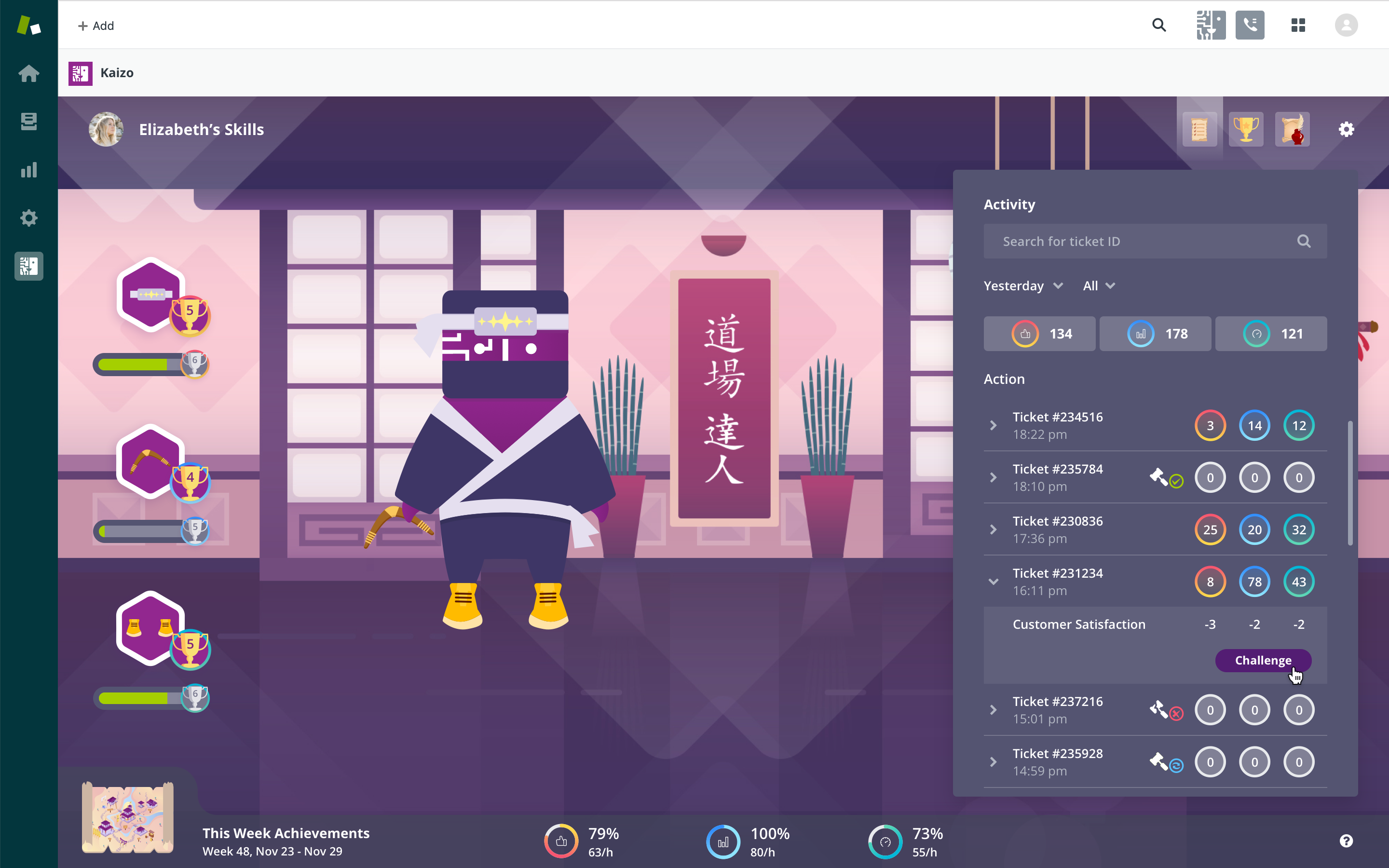
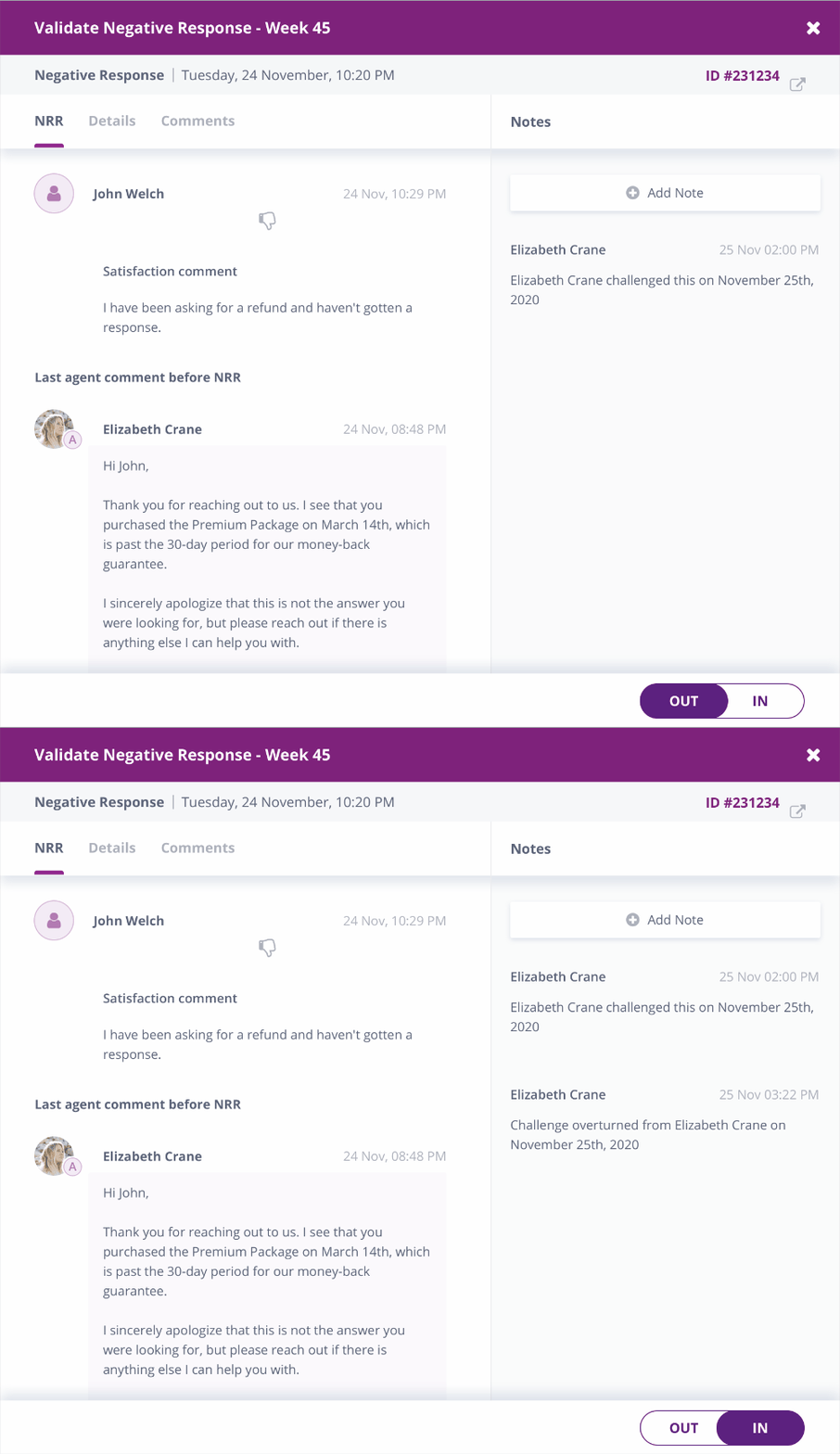
Kaizo’s NRR challenge feature allows agents to fairly challenge bad customer service reviews that they believe to be out of their control.
Once challenged, the review is evaluated by the agent’s team lead or QA lead and if agreed upon, can be overturned and taken off their overall NRR.
This gives agents a true NRR– filled only with responses where they truly could have performed better. It allows them to feel fairly evaluated, improve from these valid sets of feedback, and motivates them to develop their service skills..
“I used to get a lot of complaints from agents about how they felt unfairly evaluated by non-performance related negative responses. Now that the ball is in their court they’re noticeably more motivated to improve their responses and achieve their weekly goals”
Sophia Spagnuolo, QA lead at Fetchpackage
If measured and used correctly bad customer service reviews can be the secret ingredient to continually developing your team. From the engagement and performance of your agents to the advocacy of your customer base. Who knew that getting negative feedback could be so great?
Frequently asked questions
Should you respond to every bad customer service review?
Yes, if it is on a public channel where other customers can read it. A short, specific reply shows prospects that you take problems seriously, even when you cannot change the outcome. Reviews that break the platform’s rules can be reported instead of debated.
How quickly should you respond to a negative review?
As soon as you can, ideally within a day. Some teams aim to review internal bad ratings within 24 hours, as described above, and the same rhythm works for public reviews. A fast reply that says you are looking into it beats a perfect reply a week later.
Can you delete bad customer service reviews?
Usually not. Most review platforms only remove reviews that break their policies, such as spam, fake reviews or abusive language. For everything else, a good public reply and a fix behind the scenes is the only option.
How do you prevent bad customer service reviews?
Find out why they happen. Group negative reviews by cause, check whether the same problem appears across several agents, and fix the process, knowledge base or product behind it. Then coach agents on the issues that were within their control.