Good call center QA feedback is specific, tied to a real conversation, and ends with one thing the agent will do differently next time. Below are feedback examples you can copy, plus how to phrase, time and follow up on them.
In short
- Name the exact behavior and the call it happened on.
- Start with what went well, then give one change.
- Give feedback while the call is still fresh.
- Agree a measurable goal and check it the following week.
Feedback is an essential part of the quality assurance framework for your call center, and it’s easy to get wrong. You need to watch your words, your tone and your timing. A customer service QA checklist helps you keep feedback consistent. It matters because Gallup estimates managers account for at least 70% of the variance in employee engagement: an agent’s engagement depends most on their direct manager.
Why quality feedback matters in a call center
Call centers are under pressure to deliver excellent service. That takes a clear view of what’s working, what isn’t, and how to improve.
The problem is that agents often have little insight into their own performance. Without it they can’t improve, and the call center suffers. That’s where quality feedback comes in.
Managers help agents improve through authentic, consistent communication. As Bob Nelson, author of 1001 Ways to Reward Employees, put it:
“While money is important to employees, what tends to motivate them to perform and to perform at higher levels is the thoughtful, personal kind of recognition that signifies true appreciation for a job well done.”
If agents rarely get feedback, they assume there’s nothing to improve. If the only feedback they get is occasional criticism, morale drops. Without regular positive feedback, agents disengage and stop building skills.
Call center coaching feedback examples
The fastest way to improve feedback is to make it specific. Here is the same point said two ways.
| Situation | Vague feedback | Specific feedback to copy |
|---|---|---|
| Missing greeting | “You need to be friendlier.” | “You skipped the greeting on 11 calls this week. Try opening with the customer’s name and asking how you can help. Here’s a script.” |
| Good handling of a refusal | “Nice job on that call.” | “On the refund call this morning you listened to the full complaint and explained why we couldn’t refund. The customer still wasn’t happy, but you did a great job.” |
| Agent lost patience | “You were rude.” | “I can see why you were frustrated. That was a tough call. Let’s work out what you can do when you feel it building, so you can stay kind with the customer.” |
| Compliance miss | “Follow the security process.” | “On two calls you confirmed the address before the date of birth. Our rule is date of birth first. Can you walk me through why it happened?” |
| Hitting a personal goal | “Good work on training.” | “You set yourself three eLearning courses and finished four. That’s the kind of drive I want to see. What did you pick up that you’re using already?” |
| Asking for the agent’s view | “Any questions?” | “What can I do to help you work more productively? And how would you prefer to get feedback about your work?” |
Each specific example names the behavior, points to evidence and gives a next step. That’s the pattern to follow.
3 tips on how to give feedback to an agent
The best customer service leads are coaches, not scorekeepers.
Keeping score is easier than coaching, so it’s tempting to focus on whether agents follow processes and how fast they work. That doesn’t improve the customer experience. It can even backfire: agents fixated on their manager’s metrics miss chances to delight customers or fully resolve issues.
To improve the experience, spend more time coaching agents on quality. Helpful feedback is:
- Carefully and correctly phrased
- Accompanied by the right non-verbal cues
- Timely and consistent
1. How to phrase feedback
Phrasing matters in all communication, and most of all when you’re talking about someone’s work. Nobody wants to hear only about their shortcomings, so careful phrasing makes agents more receptive.
- Stay neutral. Focus on concrete, measurable data, not personal opinions. Emotional feedback puts agents on the defensive and gives them nothing to act on. Neutral, data-based feedback makes 1:1s more efficient because it pinpoints what needs to change.
- Go beyond results. Everyone wants higher customer satisfaction, but quality feedback covers processes, soft skills, compliance and outcomes as well as the score.
- Praise first, then give constructive feedback. Count the agent’s wins before you get to what needs work. The feedback lands better and the agent feels valued.
- Be specific and data-driven. Criticism is only constructive if it’s specific and actionable. “Be friendlier” isn’t. “You skipped the greeting 11 times this week, here’s a script” is.
- Give agents ownership. Make feedback a conversation. Ask questions, and listen to the answers. The people on the phones every day often know best how to improve the call center.
- Back it up with real examples. Play the recording or open the ticket so the agent can see exactly how the feedback applies to their work.
Example: you can reward productivity by giving feedback on personal goals. If an agent set a goal of three eLearning courses and beat it, celebrate that.
2. What your non-verbal cues are saying
Non-verbal cues matter as much as phrasing. Feelings change your tone and body language, so give feedback when you’re calm. Giving feedback can be as hard for a manager as receiving it is for an agent. If you’re wound up, take a few deep breaths, or wait.
Agents’ non-verbal cues also tell you how receptive they’ll be.
Example: an agent who just handled an angry customer may still be on edge. If they’re speaking louder than usual, breathing heavily or close to tears, give them time to calm down before you give feedback.
3. How to give feedback on the right timeline
Once you know what to say and how, get the timing right. When feedback is part of the regular workflow it’s expected, and agents stop dreading it.
- Give regular, timely feedback. Give positive feedback right away. For a specific negative incident, let the agent cool off, but deliver it while the call is still fresh.
- Follow up. Set the expectation that you’ll check back.
Example: if you gave an agent a script for friendlier greetings and you hear them use it, give a thumbs up or a smile while they’re still on the call. Then set a goal together. If they missed the greeting 11 times in a week, aim for fewer than two next week, and tell them when you’ll check in.
How to give call center quality feedback that works
Now that you know what to say, how to say it and when, here are the practices that make it stick.
Use call center quality assurance software
Timely, consistent feedback at scale needs software. Integrated QA software lets you score conversations and give feedback without leaving your helpdesk.
Give feedback in the right setting
Positive feedback works in private or in public. Constructive criticism never belongs in a group. Find a private, less formal place to talk.
Example: grab a coffee with the agent and keep it to an informal chat to put them at ease.
Use the sandwich technique, with care
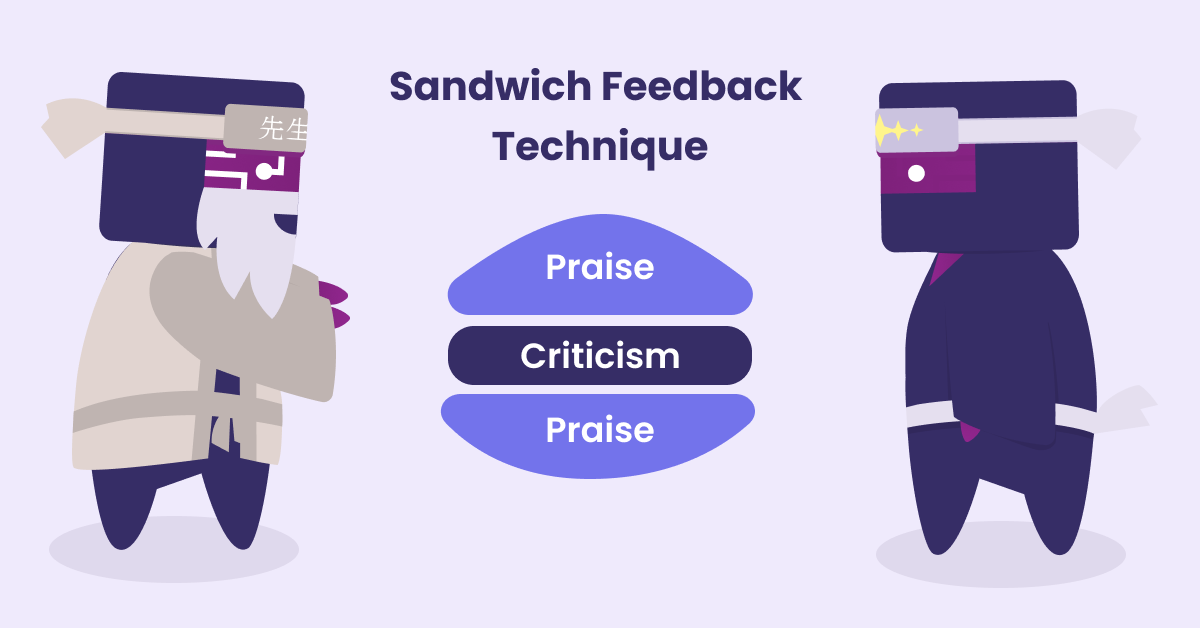
Don’t make a session all about criticism. Agents make mistakes, and they also have plenty of achievements worth naming. Open with a positive, follow with the change you need, close with another positive. Keep the praise real and specific: agents learn to ignore a compliment that only exists to soften the criticism.
Survey customers after the call
Customer feedback sharpens yours. Ask customers to complete a short survey after each call. It gives you evidence for your feedback and feeds your product feedback loop.
Let agents self-score
Give agents the call scoring form and let them grade their own call. When you meet, compare their score with yours. Agents who score themselves are more open to your feedback.
Use positive words
Instead of “Don’t do this” or “You shouldn’t do that”, say “Do this” or “Try this”. Positive phrasing sets a better tone and gives a clearer instruction.
Be direct and simple
Get to the point. Straightforward praise and straightforward criticism are both easier to understand.
Example: “I’d like to give you some feedback on your last call. I really liked how you actively listened to the customer’s complaints and showed kindness. The customer may still not be happy because we can’t give them a refund, but you did a great job.”
For an agent who didn’t handle the same call kindly: “I can see why you were frustrated. That was a tough call. Let’s brainstorm some ways to calm yourself down when you’re feeling frustrated, so you can deal with the customer’s issue with kindness.”
How QA turns feedback into a routine
Feedback is only as good as the evidence behind it, and most teams only review a handful of calls per agent each month. That makes feedback feel random to the agent and easy to dispute. Scoring every conversation with automated QA gives you the full pattern, such as how many calls skipped the greeting this week, instead of one call you happened to pick. You can then attach the feedback to the exact conversations it came from with coaching cards and check progress the following week. The manager spends the time on the conversation with the agent, not on finding examples.
Build your QA checklist for feedback
Feedback also needs solutions. A custom QA checklist helps you build training and a coaching culture that’s useful to your team. Make sure it is:
- Measurable. Tie training to specific outcomes so you can measure whether it worked. For example, if you want better compliance, check whether agents followed the rules for securely collecting data.
- Memorable. Training only works if it sticks. Interactive sessions and role plays on real calls engage agents and make lessons easier to recall.
- Motivating. Make agents want to learn. A break from the phones for training can itself be motivating, and a friendly competition with small incentives, like a longer lunch break or donuts in the breakroom, helps too.
Frequently asked questions
What is an example of good feedback for a call center agent?
“You skipped the greeting on 11 calls this week. Try opening with the customer’s name and asking how you can help, and we’ll check again next Friday.” It names the behavior, gives the evidence and sets a measurable goal. Positive feedback should be just as specific about what the agent did well.
How often should call center agents get feedback?
Give quick positive feedback as it happens, and hold a structured coaching session at least every couple of weeks. The point is consistency. Agents who hear from their manager only when something goes wrong learn to dread feedback.
How do you give constructive feedback to an agent?
Do it in private, start with something they did well, and focus on one behavior backed by a real call. Ask for their view before suggesting a fix. Agree a goal you can measure and a date to review it.
What should a call center QA feedback form include?
The scorecard criteria with a score for each, the conversation it refers to, what went well, one or two things to change, and an agreed next step. Leave space for the agent’s own score and comments. Our QA scorecard guide covers the criteria in more detail.
Make quality feedback part of your routine
With the right tools, quality feedback becomes an efficient habit for you and your agents. Kaizo plugs into your helpdesk, so you score conversations and give feedback without leaving it, and missions tie that feedback to goals agents want to hit. To see how it would work for your team, book a demo.